
How do you calculate the right circuit breaker size? You calculate it by determining the total electrical load of the circuit and then selecting a breaker that can safely handle that load, with a buffer for surges. This guide will help you do just that.
Choosing the correct circuit breaker size is crucial for electrical safety and the longevity of your appliances. An incorrectly sized breaker can lead to electrical fires, damage to equipment, and power outages. This comprehensive circuit breaker sizing guide is designed to help you navigate the process of how to determine circuit breaker size accurately for your home or business. We’ll cover everything from basic principles to specific types of breakers.
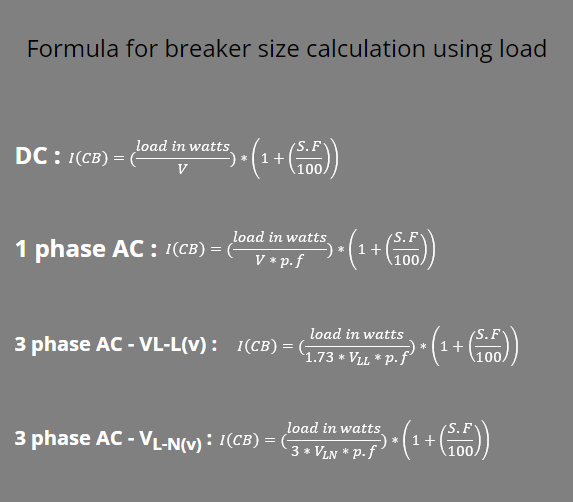
Image Source: res.cloudinary.com
Deciphering Breaker Amperage Calculation
The core of sizing a circuit breaker lies in its amperage rating. The breaker amperage calculation isn’t overly complex, but it requires attention to detail. You need to figure out how much electrical current (measured in amperes or amps) the devices on a particular circuit will draw.
Identifying Your Electrical Loads
The first step in any load calculation for circuit breakers is to identify all the devices that will be powered by that specific circuit. This includes lights, outlets, appliances, and any dedicated equipment.
- Lights: Check the wattage of your light bulbs.
- Outlets: Consider what devices will typically be plugged into these outlets.
- Appliances: Look for the power consumption (wattage or amperage) on the appliance’s label. This is often found on a sticker on the back or bottom of the appliance.
Converting Wattage to Amperage
Most appliances are rated in watts (W), but circuit breakers are rated in amperes (A). You’ll need to convert watts to amps using Ohm’s Law, specifically the formula:
Amps (A) = Watts (W) / Volts (V)
In most homes, the standard voltage for most circuits is 120 volts. Some larger appliances might use 240 volts. Always check your home’s voltage.
Example: A 1000-watt microwave running on a 120-volt circuit will draw:
1000 W / 120 V = 8.33 A
Accounting for Continuous Loads
For loads that are expected to run for three hours or more continuously (like certain lighting or sump pumps), the National Electrical Code (NEC) requires the circuit to be sized at 125% of the continuous load. This is a critical safety factor to prevent overheating.
Calculation for Continuous Loads:
Breaker Size = (Total Amps of Continuous Load × 1.25)
Example: If a circuit powers lighting that continuously draws 10 amps:
Breaker Size = 10 A × 1.25 = 12.5 A
You would then choose the next standard breaker size up, which is typically 15 amps.
Wire Size for Breaker: A Critical Pairing
The wire size for breaker selection is as important as the breaker itself. The wire needs to be able to handle the current the breaker allows without overheating. Using wire that is too thin for the breaker size is a major fire hazard.
Wire Gauge and Amperage Ratings
Electrical wires are categorized by their gauge, with lower gauge numbers indicating thicker wires that can handle more current. The NEC specifies minimum wire gauges for different breaker sizes.
Here’s a general guideline, but always refer to the latest NEC or local electrical codes for precise requirements:
| Breaker Size (Amps) | Minimum Copper Wire Gauge (AWG) |
|---|---|
| 15 | 14 |
| 20 | 12 |
| 30 | 10 |
| 40 | 8 |
| 50 | 6 |
| 60 | 4 |
Note: Aluminum wire has different gauge requirements and is generally not used for branch circuits in modern residential wiring due to safety concerns and expansion issues.
Why Matching Matters
If you have a 20-amp breaker, you must use at least 12-gauge wire. If you use 14-gauge wire (rated for 15 amps) with a 20-amp breaker, the wire can overheat and melt before the breaker trips, posing a significant fire risk. Conversely, using wire that is too thick for the breaker rating isn’t necessarily dangerous in terms of fire, but it’s an inefficient use of materials and can lead to nuisance tripping if the wire gauge isn’t properly matched to the breaker’s intended load.
Electrical Panel Breaker Sizing Strategies
Your electrical panel breaker sizing involves organizing your home’s circuits and ensuring each has an appropriately sized breaker.
The 80% Rule for General Circuits
For circuits that are not dedicated to specific appliances, the general rule is to load the circuit to no more than 80% of its breaker’s capacity. This accounts for startup surges and ensures the breaker doesn’t trip unnecessarily.
Calculation:
Maximum Load = Breaker Amps × 0.80
Example: For a 15-amp breaker, the continuous load should not exceed 12 amps (15 A × 0.80 = 12 A). For a 20-amp breaker, the continuous load should not exceed 16 amps (20 A × 0.80 = 16 A).
Dedicated Circuits
Major appliances like refrigerators, ovens, microwaves, and air conditioners often require their own dedicated circuits. This is because they can draw a significant amount of power, sometimes intermittently or during startup.
- Refrigerators: While they don’t run constantly, refrigerators have compressors that can draw a surge of power when starting. A dedicated 15-amp or 20-amp circuit is usually recommended.
- Ovens and Ranges: These high-wattage appliances typically require 240-volt circuits with breakers ranging from 30 amps to 50 amps, depending on the model.
- Microwaves: Many microwaves need a dedicated 20-amp circuit to avoid tripping the breaker when other items are also in use on a shared circuit.
Small Appliance Branch Circuits
Kitchen and dining areas often have multiple outlets. The NEC requires at least two 20-amp small appliance branch circuits for these areas. These circuits are specifically for outlets, not for stationary appliances like dishwashers or disposals. They should not be used for lighting.
Specific Breaker Types and Sizing
Beyond standard breakers, there are specialized types like AFCI and GFCI breakers, each with its own sizing considerations.
Single-Pole Breaker Sizing
A single-pole breaker sizing is used for 120-volt circuits. These protect individual branch circuits for outlets, lighting, and smaller appliances. The calculation method discussed earlier—adding up the wattage of devices and converting to amps, then applying the 80% rule or 125% for continuous loads—is directly applicable to single-pole breaker sizing.
Double-Pole Breaker Sizing
A double-pole breaker sizing is used for 240-volt circuits, which power larger appliances that require two hot wires. When calculating the size for a double-pole breaker, you consider the total wattage of the appliance and divide it by the higher voltage (240V).
Calculation:
Amps (A) = Watts (W) / Volts (V) (where V = 240V)
The 80% rule also applies to continuous loads on double-pole breakers.
Example: A 4800-watt electric dryer on a 240-volt circuit.
Amps = 4800 W / 240 V = 20 A
For continuous operation, you’d typically size the breaker at 125% of this: 20 A × 1.25 = 25 A. However, since 25-amp double-pole breakers are not standard, you would typically use a 30-amp double-pole breaker, ensuring the wire gauge is appropriate (usually 10-gauge copper). Always check the appliance manufacturer’s specifications for their recommended breaker size.
AFCI Breaker Sizing
AFCI breaker sizing (Arc Fault Circuit Interrupter) is about protecting against fires caused by electrical arcs. These breakers are required in many living areas of homes by the NEC. Sizing an AFCI breaker follows the same load calculation principles as standard breakers. The key is that the AFCI breaker is essentially a standard breaker with an added arc-fault sensing technology. You still calculate the total load and select the breaker based on that, ensuring you meet the amperage and wire gauge requirements. Common AFCI breaker sizes are 15A and 20A.
GFCI Breaker Sizing
GFCI breaker sizing (Ground Fault Circuit Interrupter) is designed to protect people from electric shock by detecting ground faults (electricity leaking to ground). GFCI protection is required in areas near water, such as bathrooms, kitchens, garages, and outdoors. Like AFCIs, GFCI breakers are typically standard circuit breakers with added ground-fault sensing. You calculate the load as usual and select the appropriate amperage (commonly 15A or 20A) for the circuit. The GFCI feature doesn’t change the basic load calculation for sizing.
Practical Steps to Calculate Your Breaker Size
Let’s walk through a practical example to solidify the process.
Scenario: Kitchen Countertop Outlets
Objective: Determine the breaker size for a new circuit feeding kitchen countertop outlets.
- Identify Loads: You want to provide power for countertop outlets where various appliances might be used simultaneously, like a toaster, coffee maker, and blender.
- Estimate Maximum Simultaneous Use: It’s unlikely all appliances will run at their maximum wattage at the exact same time. However, for safety, you should consider a reasonably high load. Let’s assume:
- Toaster: 1200 watts
- Coffee Maker: 1000 watts
- Blender: 500 watts
- General outlets for other items (e.g., charging phone, running a small appliance): Estimate an additional 500 watts to be safe.
- Calculate Total Wattage: 1200 W + 1000 W + 500 W + 500 W = 3200 watts.
- Convert to Amps: Assuming 120 volts:
3200 W / 120 V = 26.67 amps. -
Apply the 80% Rule: Since these are general-purpose outlets and not a single continuous load appliance, we apply the 80% rule to the breaker’s capacity. The circuit should not be continuously loaded beyond 80% of its rating.
- If we considered a 20-amp breaker: 20 A × 0.80 = 16 amps.
- The calculated load of 26.67 amps significantly exceeds the safe 80% capacity of a 20-amp circuit.
-
Re-evaluate: A single 20-amp circuit is not sufficient if we anticipate using these appliances simultaneously. The NEC requires at least two 20-amp small appliance branch circuits for kitchens. This scenario highlights why dedicated circuits and proper distribution are important.
Let’s revise for a single dedicated circuit for, say, a powerful stand mixer that draws a lot.
Scenario: Dedicated Stand Mixer Outlet
Objective: Size a dedicated circuit for a high-power stand mixer.
- Identify Load: Stand Mixer: 750 watts.
- Convert to Amps: 750 W / 120 V = 6.25 amps.
- Check for Continuous Load: Stand mixers are typically used intermittently, not for hours on end. Therefore, the 125% rule for continuous loads doesn’t strictly apply here. However, it’s good practice to have some headroom.
-
Apply 80% Rule for Safety Margin:
- A 15-amp breaker (rated for 15A) has a safe continuous load of 15 A × 0.80 = 12 amps. The mixer’s 6.25 amps fits comfortably within this.
- A 20-amp breaker (rated for 20A) has a safe continuous load of 20 A × 0.80 = 16 amps.
-
Select Breaker and Wire: A 15-amp breaker with 14-gauge wire would be sufficient for this mixer if it were the only thing on the circuit and used intermittently. However, it’s good practice in kitchens to use 20-amp circuits for outlets due to the general expectation of higher power draw from various appliances. So, a 20-amp breaker with 12-gauge wire is a more robust and future-proof choice for a dedicated outlet.
Safety First: When to Call a Professional
While this guide provides a solid foundation for how to calculate circuit breaker size, electrical work can be dangerous. If you are unsure at any point, or if the calculations result in a breaker size that doesn’t align with standard available breakers (e.g., needing exactly 17.5 amps), it is always best to consult a qualified electrician. They have the expertise, tools, and knowledge of local codes to ensure your electrical system is safe and up to standard.
Key Takeaways for Breaker Sizing:
- Know Your Loads: Accurately list all devices and their power consumption.
- Convert Watts to Amps: Use the formula A = W / V.
- Apply the 80% Rule: For general circuits, don’t exceed 80% of the breaker’s capacity for continuous loads.
- Use 125% for Continuous Loads: For devices that run 3+ hours, multiply their amp draw by 1.25.
- Match Wire Gauge to Breaker: Ensure your wire is rated for the breaker’s amperage.
- Dedicated Circuits: Essential for high-draw or critical appliances.
- AFCI/GFCI: These add safety features without changing the fundamental load calculation for sizing.
By following these steps, you can confidently determine the correct circuit breaker size for your electrical needs, ensuring safety and reliability.
Frequently Asked Questions (FAQ)
Q1: Can I replace a 15-amp breaker with a 20-amp breaker if the wire seems thick enough?
A1: No, you should not do this without verifying the wire gauge is rated for 20 amps. Replacing a breaker with a higher amperage rating than the circuit wiring can safely handle is a significant fire hazard. The wire could overheat and melt before the new, higher-rated breaker trips. Always ensure the wire gauge matches or exceeds the breaker’s rating.
Q2: What happens if my circuit breaker trips often?
A2: Frequent breaker tripping usually indicates that the circuit is overloaded (drawing more power than it’s designed for) or there’s a fault in the circuit. You need to perform a load calculation for circuit breakers to see if you’ve exceeded the circuit’s capacity. If the load seems appropriate, there might be an issue with the wiring, the breaker itself, or an appliance on the circuit.
Q3: Do I need to consider the amperage rating of the outlets and switches?
A3: Yes. Outlets and switches have their own amperage ratings. For a standard 15-amp circuit, you should use 15-amp rated outlets and switches. For a 20-amp circuit, you should use 20-amp rated outlets. Some 15-amp circuits can have duplex receptacles (two outlets) where one half is rated for 20 amps on the “parallel” or “T-slot” terminal. However, it’s often simpler and compliant to use 20-amp receptacles on 20-amp circuits.
Q4: How do I calculate the breaker size for a new addition or renovation?
A4: For a new addition or renovation, you’ll need to perform a complete electrical panel breaker sizing assessment. This involves calculating the total anticipated electrical load for the entire space, including lighting, receptacles, dedicated appliances, HVAC, and any other electrical equipment. This calculation is often complex and may require an electrician to ensure compliance with the NEC and local building codes.
Q5: What is the difference between a standard breaker, AFCI breaker, and GFCI breaker regarding sizing?
A5: The fundamental breaker amperage calculation remains the same for all these types of breakers. The difference lies in their protective functions. Standard breakers protect against overcurrents (overloads and short circuits). AFCI breakers add protection against dangerous arc faults. GFCI breakers protect against ground faults, preventing electric shock. When AFCI breaker sizing or GFCI breaker sizing, you perform the same load calculations as for a standard breaker to determine the appropriate amperage, and then select the AFCI or GFCI version of that breaker.