
Image Source: media.cheggcdn.com
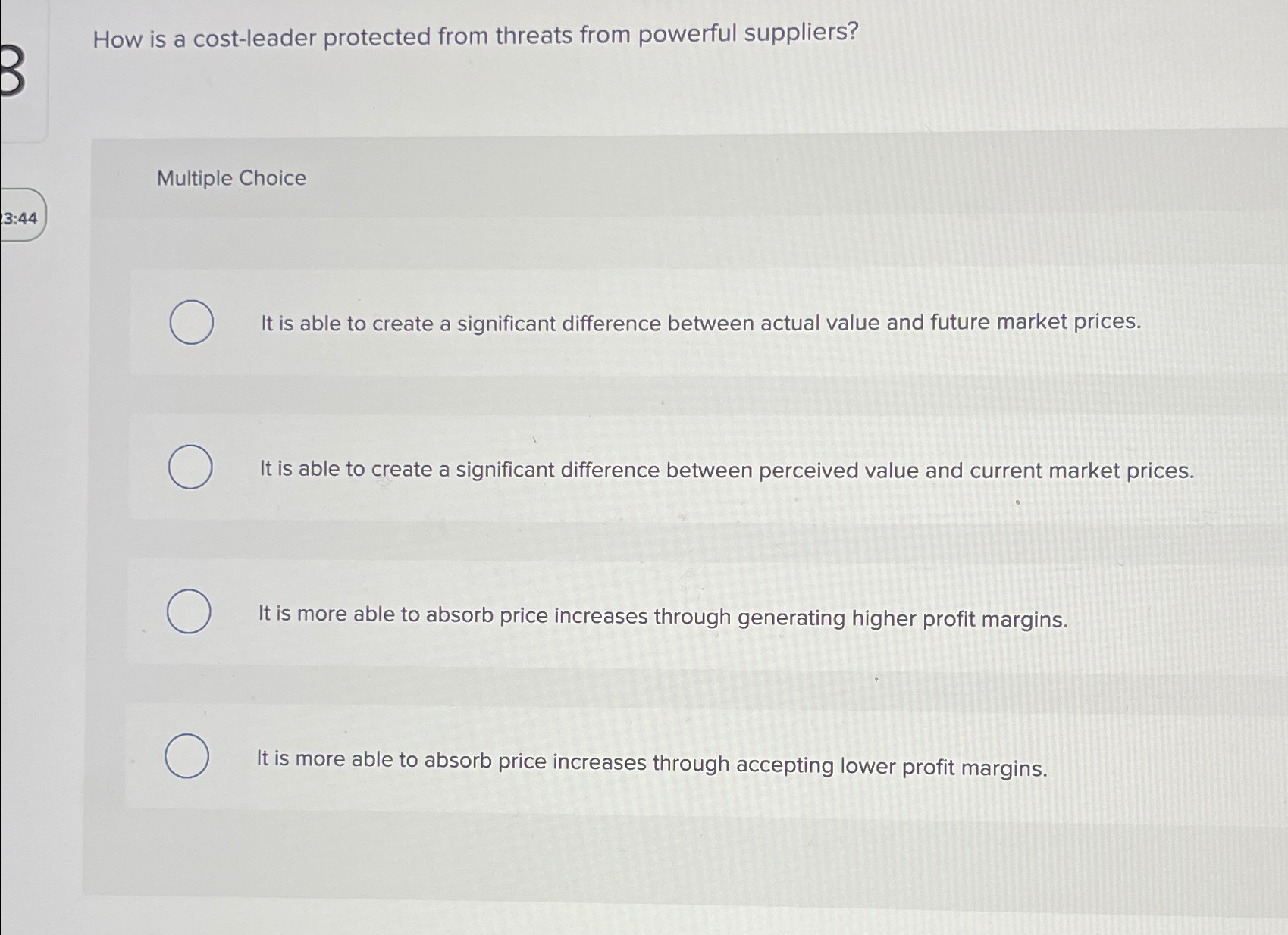
How Is A Cost-Leader Protected From Threats From Powerful Suppliers?
A cost-leader protects itself from powerful suppliers through a combination of strategic sourcing, operational efficiency, and leveraging its market position. What are the main ways a cost-leader defends against supplier threats? The primary methods include building strong supplier relationships, diversifying the supplier base, achieving economies of scale, and exploring integration strategies.
The business world is a dynamic arena, and for companies striving to be cost-leaders, navigating the power dynamics with their suppliers is crucial for sustained success. Powerful suppliers, possessing significant market share or control over unique resources, can exert considerable pressure, potentially eroding a cost-leader’s hard-won advantage. This article delves into the multifaceted strategies cost-leaders employ to shield themselves from these threats, ensuring their competitive edge remains sharp.
The Core Challenge: Supplier Bargaining Power
At the heart of this defense lies the concept of bargaining power. As defined by Michael Porter’s Five Forces framework, supplier bargaining power is a significant force that can reduce industry profitability. Powerful suppliers can:
- Increase prices: This directly impacts a cost-leader’s margins.
- Reduce quality: Compromised inputs can lead to higher defect rates and customer dissatisfaction.
- Limit availability: Shortages can disrupt production and increase lead times.
- Impose unfavorable terms: This could include extended payment periods or strict delivery schedules.
A cost-leader, by its very nature, thrives on minimizing costs. Any disruption to this delicate balance, especially from those who supply essential materials or components, poses a direct threat to its business model.
Building Robust Defenses: Key Strategies for Cost-Leaders
Cost-leaders don’t passively accept the dominance of their suppliers. Instead, they proactively build defenses. These strategies can be broadly categorized into sourcing, operational, and strategic approaches.
Strategic Sourcing and Supplier Management
The way a cost-leader selects and manages its suppliers is paramount. This involves more than just finding the lowest price; it’s about building a resilient and cost-effective supply base.
-
Supplier Diversification: Relying on a single supplier for critical inputs is a high-risk strategy. Cost-leaders actively pursue supplier diversification. This means identifying and cultivating relationships with multiple suppliers for the same or similar materials.
-
Benefits:
- Reduces dependence on any single supplier.
- Creates internal competition among suppliers, driving down prices.
- Provides alternative sources in case of supply disruptions.
- Allows for negotiation leverage.
-
Implementation: This requires thorough market research to identify potential suppliers, rigorous vetting processes, and a willingness to split business across several providers, even if it means slightly less volume discount from each individual supplier initially.
-
-
Leveraging Economies of Scale: A significant advantage for cost-leaders is their ability to achieve economies of scale. This means that as their production volume increases, the cost per unit of output decreases. When it comes to procurement, this translates into greater purchasing power.
- How it Protects:
- Larger order volumes allow cost-leaders to negotiate better prices with suppliers due to the significant business they represent.
- Suppliers are more incentivized to offer favorable terms to secure large, consistent orders from a cost-leader.
- This scale can make it difficult for smaller competitors to match the cost-leader’s purchasing power.
- How it Protects:
-
Negotiating Long-Term Contracts: Securing long-term contracts with suppliers offers a degree of price stability and predictability. This is a vital defense against price volatility.
- Key Elements of Effective Contracts:
- Fixed Pricing: Locking in prices for a specified period shields against market fluctuations.
- Volume Commitments: Guarantees a certain level of business for the supplier, making them more amenable to favorable terms.
- Performance Clauses: Including metrics for quality, delivery times, and responsiveness can ensure the supplier meets expectations.
- Escalation Clauses (Carefully Crafted): While aiming for fixed prices, some contracts might include carefully structured escalation clauses tied to objective market indices, rather than supplier discretion.
- Key Elements of Effective Contracts:
-
Building Collaborative Partnerships: While often adversarial in nature, forging collaborative partnerships with key suppliers can create mutually beneficial relationships that go beyond transactional exchanges.
-
Characteristics of Collaborative Partnerships:
- Open Communication: Sharing demand forecasts, production plans, and market insights.
- Joint Problem-Solving: Working together to improve processes, reduce waste, and enhance quality.
- Shared Risk and Reward: In some cases, partnerships might involve shared investments in new technologies or risk-sharing agreements.
- Supplier Development: Assisting suppliers in improving their own efficiency and capabilities, which can ultimately lead to lower costs for the cost-leader.
-
Impact on Supplier Power: When a supplier views the cost-leader as a strategic, long-term partner rather than just another customer, they are less likely to exploit their bargaining power for short-term gains. They have a vested interest in the cost-leader’s continued success.
-
-
Minimizing Supplier Switching Costs: The supplier switching costs are the expenses or difficulties a company incurs when changing from one supplier to another. Cost-leaders actively work to minimize these costs.
-
Strategies to Reduce Switching Costs:
- Standardization of Inputs: Using common components or raw materials that are available from multiple suppliers.
- Modular Design: Designing products in a way that allows for easier integration of components from different suppliers.
- Developing Internal Expertise: Ensuring the company has the knowledge and capability to quickly onboard and work with new suppliers.
- Maintaining Good Supplier Relationships: Even with diversified suppliers, fostering positive relationships makes transitioning smoother if needed.
-
Why This Matters: Low switching costs empower a cost-leader to change suppliers if terms become unfavorable without incurring significant disruption or expense.
-
Operational Efficiencies and Supply Chain Optimization
Beyond sourcing, a cost-leader’s internal operations and supply chain management are critical defense mechanisms.
-
Enhancing Supply Chain Efficiency: A highly efficient supply chain efficiency minimizes waste, reduces lead times, and improves inventory management.
-
Key Elements:
- Just-in-Time (JIT) Inventory: Receiving materials only as they are needed for production, reducing holding costs and the risk of obsolescence.
- Lean Manufacturing Principles: Eliminating non-value-adding activities throughout the production process.
- Optimized Logistics: Streamlining transportation and warehousing to reduce costs and improve delivery speed.
- Technology Integration: Utilizing enterprise resource planning (ERP) systems and supply chain management (SCM) software for better visibility and control.
-
Impact on Supplier Power: An efficient supply chain reduces the cost-leader’s reliance on any single point in the chain, including suppliers, by making the entire process more agile and less vulnerable to disruptions.
-
-
Proprietary Inputs and Processes: While cost-leaders often aim for standardized inputs to facilitate diversification and reduce switching costs, in some cases, they may develop or secure proprietary inputs or unique manufacturing processes.
-
How This Offers Protection:
- If a cost-leader possesses a unique technology or process that relies on a specific, hard-to-replicate input, it can actually reduce supplier power if the supplier is also dependent on the cost-leader for a significant portion of its business (e.g., if the cost-leader is the only buyer of that specific proprietary input).
- Alternatively, if the cost-leader develops a proprietary input that substitutes for a more common one, it can reduce its reliance on suppliers of the latter.
-
The Balance: This strategy must be carefully balanced. Developing proprietary inputs can be costly and may introduce new dependencies if not managed well.
-
Strategic Integration and Market Power
In more extreme cases, cost-leaders might consider deeper integration into their supply chain.
-
Forward Integration: This involves a company taking ownership of downstream activities in its value chain, closer to the end customer. For a cost-leader, this might mean establishing its own distribution network or retail outlets.
- How it Protects:
- Reduces dependence on intermediaries or distributors, who may have their own supplier-like power.
- Provides direct access to customer feedback, enabling better demand forecasting and product development.
- Can lead to cost savings by eliminating markups from third parties.
- How it Protects:
-
Backward Integration: This strategy involves a company taking ownership of upstream activities, closer to the raw materials. For a cost-leader, this could mean acquiring suppliers of critical raw materials or components.
-
Benefits:
- Direct Control over Input Costs and Quality: The cost-leader can directly manage the production and pricing of key inputs.
- Secured Supply: Ensures a consistent and reliable supply of critical materials.
- Elimination of Supplier Profit Margins: The cost-leader captures the profit that would have gone to the external supplier.
- Deters Competitors: Acquiring key suppliers can make it harder for rivals to access essential inputs.
-
Considerations: Backward integration can be capital-intensive and may divert management focus from the core business. It also means the cost-leader now faces the challenges of managing those acquired businesses, including potential labor issues, regulatory compliance, and operational complexities. However, for critical, high-volume inputs where supplier power is particularly acute, it can be a powerful defensive move.
-
The Role of Market Position
A cost-leader’s dominant market position itself is a powerful defense against supplier threats.
- High Volume and Predictable Demand: The sheer volume of business a cost-leader provides can make suppliers hesitant to alienate them. Their demand is often more predictable than that of smaller competitors, offering suppliers a stable revenue stream.
- Reputational Leverage: Suppliers may be eager to be associated with a successful cost-leader, enhancing their own reputation and market access.
Framework for Assessing Supplier Threats
To effectively manage supplier threats, cost-leaders can use frameworks like Porter’s Five Forces to analyze the intensity of supplier power. Key questions to ask include:
- Is the supplier industry concentrated? (Few suppliers vs. many)
- How important is the input to the buyer’s product? (Differentiator vs. commodity)
- What are the switching costs for the buyer?
- Does the supplier have a threat of forward integration? (Can they become a competitor?)
- How significant are the buyer’s purchases to the supplier?
By systematically evaluating these factors, cost-leaders can prioritize which suppliers pose the greatest threat and tailor their defensive strategies accordingly.
| Supplier Characteristic | Impact on Cost-Leader’s Protection | Mitigation Strategy |
|---|---|---|
| Few suppliers for critical inputs | High threat | Supplier diversification, strategic partnerships, backward integration |
| High switching costs | High threat | Minimize switching costs, standardization, modular design |
| Inputs are crucial differentiators | High threat | Joint R&D with suppliers, long-term contracts with quality clauses |
| Supplier has threat of forward integration | High threat | Focus on competitive advantage, strategic alliances, market dominance |
| Supplier relies heavily on buyer | Low threat | Leverage scale and volume in negotiations |
Conclusion: A Proactive and Integrated Approach
Protecting a cost-leadership position from powerful suppliers is not a single action but a continuous, integrated strategy. It requires a deep understanding of the supply market, a commitment to operational excellence, and a willingness to adapt and innovate. By diversifying suppliers, fostering collaborative relationships, achieving scale, managing switching costs, and strategically considering integration, cost-leaders can effectively neutralize or mitigate the threats posed by powerful suppliers, thereby safeguarding their competitive advantage and ensuring long-term profitability. The constant pursuit of supply chain efficiency and the smart leverage of market power are the cornerstones of this robust defense.
Frequently Asked Questions (FAQ)
Q1: What is the most effective single strategy to protect against powerful suppliers?
While there’s no single “most effective” strategy, supplier diversification is often cited as a fundamental and highly impactful defense. It directly reduces reliance and creates leverage, making it harder for any single supplier to exert undue pressure.
Q2: Can a cost-leader ever benefit from a strong relationship with a powerful supplier?
Yes, absolutely. When a powerful supplier recognizes the value and stability of a cost-leader’s business, they may offer preferential pricing, reliable supply, and collaborative innovation. This shifts the dynamic from one of pure power imbalance to a mutually beneficial collaborative partnership.
Q3: How do proprietary inputs affect the supplier-cost-leader relationship?
If a cost-leader develops proprietary inputs that are unique and critical to their operations, and the supplier is the sole producer of these inputs, the supplier may gain significant power. However, if the cost-leader’s process using these inputs creates a substantial competitive advantage and volume for the supplier, the cost-leader can still leverage this to negotiate favorable terms. Conversely, if the cost-leader develops a proprietary input that substitutes for a common material, it reduces their reliance on suppliers of that common material.
Q4: What are the risks of backward integration for a cost-leader?
The primary risks include significant capital investment, increased operational complexity, potential dilution of management focus from core competencies, and the challenge of managing a different type of business (the supplier’s business). There’s also the risk that integrating a supplier might not achieve the expected cost savings or quality improvements.
Q5: How does improving supply chain efficiency help against supplier threats?
Improving supply chain efficiency reduces the cost-leader’s vulnerability to supplier disruptions. By optimizing inventory, reducing lead times, and improving logistics, the company can absorb minor supply fluctuations more easily and is less dependent on any single supplier for immediate needs. This agility enhances their negotiating position.