
In a 3-phase circuit breaker, amperage is not “divided” in the traditional sense; instead, the total connected load’s current is distributed across the three individual phases. Each pole of the circuit breaker is designed to handle the amperage of its respective phase.
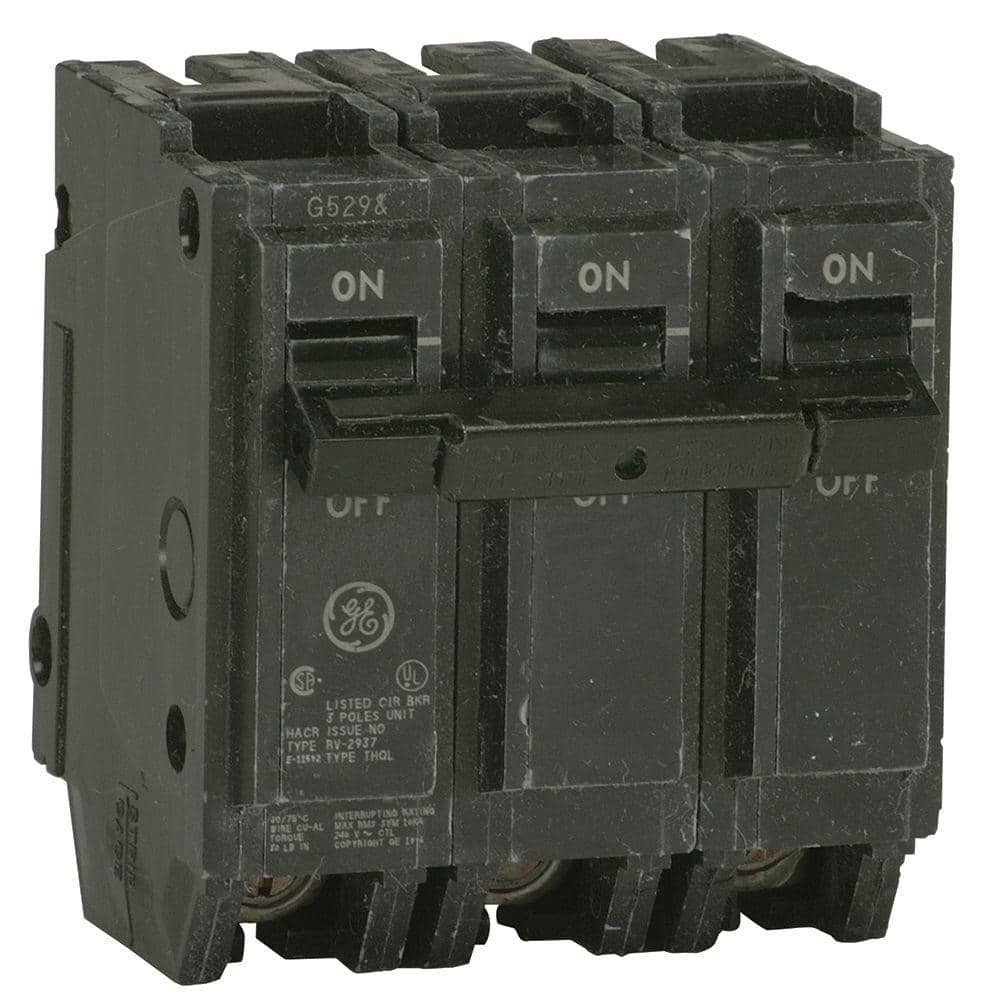
Image Source: images.thdstatic.com
The Fundamentals of Three-Phase Power
Three-phase power is a fundamental concept in electrical engineering, especially for powering industrial machinery and large commercial buildings. Unlike single-phase power, which uses two wires (hot and neutral), three-phase power utilizes three “hot” wires and often a neutral wire. These three hot wires carry alternating current (AC) waveforms that are out of sync with each other by 120 degrees. This unique phasing provides several advantages, including a more constant power delivery and the ability to start motors more efficiently.
Why Three-Phase Power?
The benefits of three-phase power are numerous:
- Constant Power Delivery: The overlapping nature of the three AC waveforms ensures that power is delivered more smoothly and consistently than with single-phase power. This is crucial for sensitive equipment.
- Motor Efficiency: Three-phase motors are generally more efficient, simpler in design, and require less maintenance than their single-phase counterparts. They can also start under load without needing special starting capacitors.
- Reduced Conductor Size: For the same amount of power transmitted, three-phase systems can use smaller conductors than single-phase systems. This translates to lower material costs for wiring.
- Versatility: Three-phase systems can easily provide both three-phase power and, by using one of the phases and the neutral wire, single-phase power.
Current Distribution in Three-Phase Systems
In a balanced three-phase system, the current drawn by the loads should be equal on all three phases. This ideal scenario is known as phase balance. When a load is perfectly balanced, the current flowing through each hot wire of the system, and therefore through each pole of the circuit breaker, will be the same.
Current distribution is the process by which electrical current flows from the power source through the conductors to the loads. In a three-phase system, this distribution happens independently on each phase, but they are interconnected by the nature of the load.
The Role of the Circuit Breaker in Three-Phase Circuits
A circuit breaker is a vital safety device designed to protect electrical circuits from damage caused by overcurrents, whether from overloads or short circuits. In a three-phase circuit breaker, each pole is responsible for interrupting the flow of current on one of the three phases.
Single-Pole vs. Three-Pole Circuit Breakers
- Single-Pole Circuit Breakers: These are designed for single-phase circuits and have only one set of contacts to interrupt the hot wire.
- Three-Pole Circuit Breakers: These are used in three-phase circuits and have three sets of contacts, one for each phase. When a fault occurs, all three poles trip simultaneously, disconnecting all phases of the three-phase supply. This is critical for preventing imbalances and potential damage to three-phase equipment.
Circuit Breaker Amp Rating
The circuit breaker amp rating (e.g., 10A, 20A, 50A) indicates the maximum continuous current the breaker can safely carry without tripping. For a three-phase circuit breaker, this rating applies to each pole. So, a 50A three-pole circuit breaker can safely carry up to 50A on phase A, 50A on phase B, and 50A on phase C, provided the load is balanced.
It’s crucial to select a circuit breaker with an amp rating that matches or is slightly higher than the expected maximum load current for each phase. However, it must also be sized according to the conductor’s ampacity to prevent wire overheating.
Overload Protection
Overload protection is a primary function of circuit breakers. An overload occurs when a circuit draws more current than it is designed to handle for an extended period. This could be due to too many appliances connected to a circuit or a motor drawing more power than it needs. In a three-phase circuit breaker, if one phase experiences an overload, that specific pole will detect the excessive current and trip, interrupting the flow of electricity on that phase. A properly designed three-pole breaker will ensure all phases are disconnected, even if only one phase is overloaded, to maintain phase balance and prevent damage to three-phase motors.
How Amperage is Handled Per Phase
The core principle is that the circuit breaker’s rating is per pole, and each pole monitors and protects a single phase.
Load Sharing in Three-Phase Systems
Load sharing refers to how the total electrical load is distributed among the different phases of a three-phase system. In an ideal scenario, a three-phase load is designed to draw equal amounts of power from each phase. For example, a three-phase motor is designed to have its windings connected in a way that promotes equal current draw.
When a load is applied, the current flows from the source, through the circuit breaker’s poles, and to the connected equipment.
Let’s consider a simplified scenario:
Imagine a three-phase load that requires 30 amps in total. If this load is perfectly balanced, then:
- Phase A will draw 10 amps.
- Phase B will draw 10 amps.
- Phase C will draw 10 amps.
In this case, a three-pole circuit breaker rated for at least 10 amps per pole (e.g., a 15A or 20A breaker) would be appropriate for each pole. The breaker’s internal mechanism for each pole would see 10 amps, well within its capacity.
What Happens with Unbalanced Loads?
In reality, perfect three-phase load balancing is often difficult to achieve. Various factors can lead to an imbalance in the current drawn by the three phases:
- Unequal Loads: Connecting different single-phase loads to different phases. For example, if you have a three-phase panel and connect several single-phase appliances primarily to Phase A and very few to Phase C, Phase A will carry more current.
- Motor Issues: A fault within a three-phase motor can cause one phase to draw significantly more current than the others.
- Conductor Issues: Differences in conductor resistance or loose connections can also lead to imbalances.
If a load is unbalanced, the amperage per phase will differ. For example, with the same total load of 30 amps, an unbalanced scenario might look like this:
- Phase A: 15 amps
- Phase B: 10 amps
- Phase C: 5 amps
In this situation, the pole of the circuit breaker connected to Phase A would experience 15 amps. The circuit breaker must be sized to handle the highest anticipated current on any single phase.
The Neutral Current
In a standard four-wire three-phase system (typically Wye or Star configuration), there is a neutral wire. The neutral wire connects to the common point of the three phases.
Neutral current is the current that flows through the neutral wire. In a perfectly balanced three-phase system with no single-phase loads connected between phases and neutral, the neutral current should ideally be zero. This is because the currents in the three phases are 120 degrees apart, and their vector sum is zero.
However, when single-phase loads are connected between phases and the neutral wire, or when there’s an imbalance in the three-phase loads, a neutral current will flow. This neutral current is the vector sum of the currents flowing in the three phases.
Important Note: Standard three-pole circuit breakers for three-phase loads (like motors) do not typically include a neutral pole, as the neutral is not part of the three-phase circuit itself. They are designed to protect the three “hot” phases. However, when supplying mixed loads (both three-phase and single-phase loads), a four-pole circuit breaker might be used, where the fourth pole is for the neutral conductor. In such cases, the neutral pole’s amp rating is also critical.
Circuit Breaker Design for Three-Phase Loads
A three-pole circuit breaker is essentially three single-pole breakers housed in a single unit. Each pole has its own thermal and magnetic tripping mechanisms that respond to overcurrents on its specific phase.
Thermal-Magnetic Trips
Most circuit breakers employ thermal-magnetic tripping mechanisms:
- Thermal Trip: This element, usually a bimetallic strip, heats up when current flows through it. If the current exceeds a safe level for an extended period (an overload), the strip bends and triggers the tripping mechanism. This provides protection against sustained overloads.
- Magnetic Trip: This element, typically an electromagnet, responds instantly to sudden surges in current, such as those caused by short circuits. If the current is high enough, it generates a magnetic field strong enough to pull a lever and trip the breaker immediately.
In a three-pole breaker, each pole has its own thermal and magnetic trip unit. If Phase A exceeds its limit, the thermal or magnetic trip in the Phase A pole activates, causing all three poles to open simultaneously. This ensures that the equipment is de-energized completely and maintains phase balance by preventing it from running on only two phases, which can be detrimental to motors.
Selective Tripping and Coordination
In some complex industrial systems, multiple circuit breakers are arranged in series. Circuit breaker amp rating selection becomes critical for proper coordination. Selective tripping ensures that only the breaker closest to the fault trips, isolating the fault without disrupting other parts of the system. This is achieved by using breakers with different tripping characteristics and current transformer ratios if current transformers are used for sensing.
Sizing a Three-Phase Circuit Breaker
Proper sizing is paramount for safety and efficient operation.
Steps for Sizing a Three-Phase Circuit Breaker:
- Determine the Full Load Amps (FLA) of the Load: For motors, this information is typically found on the motor nameplate. For other equipment, consult the manufacturer’s specifications.
- Calculate the Amperage Per Phase: For a balanced three-phase load, divide the total FLA by the square root of 3 (approximately 1.732).
Amps per Phase = Total FLA / 1.732- For example, if a three-phase motor has an FLA of 25A, the amperage per phase is approximately 25A / 1.732 ≈ 14.4A.
- Apply Correction Factors:
- Continuous Loads: For loads operating for three hours or more, the National Electrical Code (NEC) requires the circuit breaker and conductors to be sized at 125% of the continuous load.
- Motor Overload Protection: Motors often have specific rules for overload protection, which may involve sizing the overload device at a different percentage of the FLA.
- Select the Next Standard Ampere Rating: After applying any necessary correction factors, choose the next standard ampere rating of the circuit breaker that is equal to or greater than the calculated value. For example, if the calculated continuous load for a phase is 18A, you would select a 20A breaker.
- Consider the Conductors: Ensure the selected circuit breaker’s amp rating is less than or equal to the ampacity of the conductors supplying the load, as per NEC tables.
Example Calculation
Let’s consider a three-phase motor with a nameplate FLA of 40A. It operates continuously.
- FLA: 40A
- Amps per Phase (unadjusted): 40A / 1.732 ≈ 23.1A
- Continuous Load Adjustment: For continuous operation, we need to size at 125% of the load.
- Required ampacity = 23.1A * 1.15 (often used for motor circuit feeders to account for starting current, though breaker sizing might be at 125% of FLA) Let’s follow NEC general continuous load rules for clarity:
- Required ampacity = 23.1A * 1.25 = 28.875A.
- Note: Motor circuit sizing has specific rules; consult NEC Article 430 for detailed requirements, which might involve sizing based on motor horsepower and specific overload protection settings rather than just FLA directly.
- Select Breaker: Based on 28.875A, the next standard breaker size is 30A. So, a 30A three-pole circuit breaker would be appropriate for each phase, assuming the conductors are rated for at least 30A.
The Role of Current Transformers (CTs)
In larger industrial applications, current transformer ratios play a significant role in monitoring and protecting circuits. CTs are used to step down high currents to a level that can be safely handled by protection relays and metering equipment.
How CTs Work with Circuit Breakers
- A CT is installed around a conductor (like a phase wire).
- The primary winding of the CT is the conductor itself.
- The secondary winding, which is much smaller, carries a proportional, reduced current.
- The ratio of the primary current to the secondary current is the CT ratio (e.g., 100/5, meaning 100 amps primary becomes 5 amps secondary).
- Protection relays or smart circuit breakers use the secondary current from the CTs to measure the current in the circuit.
- The relay is programmed with the CT ratio, allowing it to accurately interpret the primary current.
- If the current sensed by the CT (and interpreted by the relay) exceeds a set threshold, the relay signals the circuit breaker to trip.
This is particularly useful for very high current circuits where direct sensing by a circuit breaker’s internal mechanisms would be impractical or too expensive. The CT allows for flexible adjustment of sensing thresholds by changing the relay settings, independent of the physical breaker size.
Protecting Against Imbalances and Faults
The primary goal of a three-pole circuit breaker is to ensure overload protection and fault protection for all phases of a three-phase system.
Consequences of Running on Two Phases
If a three-pole breaker were to fail to trip all three poles during a fault or overload on one phase, the motor would continue to run on the remaining two phases. This is highly detrimental:
- Overheating: The motor windings in the unfaulted phases would draw excessive current to compensate for the loss of the third phase, leading to rapid overheating and potential burnout.
- Torque Pulsation: The motor would experience significant torque pulsations, leading to vibration and mechanical stress.
- Improper Operation: The equipment driven by the motor would not operate correctly.
This is why the simultaneous tripping of all three poles in a three-pole circuit breaker is a critical safety feature.
Ensuring Phase Balance
While circuit breakers protect against overcurrents, maintaining phase balance is primarily the responsibility of the electrical system designer and the end-user. This involves:
- Proper Load Distribution: Distributing single-phase loads as evenly as possible across all three phases.
- Motor Selection: Ensuring three-phase motors are correctly sized for the application.
- Regular Maintenance: Checking connections and performing routine diagnostics on equipment to detect developing imbalances.
Summary Table: Key Concepts
| Concept | Description | Relevance to Amperage Division |
|---|---|---|
| Three-Phase Power | Electrical power delivered via three AC waveforms, 120 degrees out of phase. | Forms the basis of the current distribution. |
| Phase Balance | The ideal state where current draw is equal across all three phases. | When balanced, amperage per phase is predictable and equal. Breaker poles see the same current. |
| Current Distribution | The flow of electrical current through conductors from source to load. | In three-phase, current flows on each of the three “hot” conductors. |
| Amperage Per Phase | The amount of current flowing through a single phase conductor. | This is what each pole of the circuit breaker is designed to monitor and protect. |
| Load Sharing | How the total electrical load is distributed among the three phases. | Crucial for maintaining phase balance. Unequal load sharing leads to unbalanced amperage per phase. |
| Circuit Breaker Amp Rating | The maximum current a breaker’s pole can safely carry continuously without tripping. | This rating applies to each pole. The breaker must be rated to handle the highest anticipated amperage per phase. |
| Overload Protection | The function of a circuit breaker to interrupt current when it exceeds a safe level for a sustained period. | Each pole of a three-phase breaker provides overload protection for its respective phase. |
| Single-Pole vs. Three-Pole | Single-pole breakers protect one conductor; three-pole breakers protect three conductors simultaneously. | Three-pole breakers are essential for three-phase circuits to ensure all phases are disconnected together, maintaining phase balance and preventing damage. |
| Neutral Current | Current flowing through the neutral wire, typically due to unbalanced loads or single-phase loads connected to neutral. | Standard three-phase breakers for motor loads typically don’t have a neutral pole. For mixed loads, a four-pole breaker may be used, and neutral current must be considered in sizing and protection. |
| Current Transformer Ratios | Used in larger systems to reduce high currents to a safe level for measurement and protection relays. | Enables accurate sensing and protection for high-amperage circuits, allowing breakers to be tripped based on relayed current information corresponding to the actual amperage per phase. |
Frequently Asked Questions (FAQ)
What happens if a 3-phase motor is run on only two phases?
If a three-phase motor runs on only two phases, the remaining two windings will draw significantly more current to compensate. This will cause rapid overheating, leading to motor damage, potential burnout, and excessive vibration.
Can I use a single-pole breaker in a 3-phase circuit?
No, you should never use single-pole breakers in a three-phase circuit. Each phase must be protected by its own pole, and all poles must trip simultaneously to prevent damage to three-phase equipment and maintain safety.
How do I check for phase imbalance?
You can check for phase imbalance using a multimeter or a specialized phase meter. Measure the voltage between each phase and neutral, and then between each phase and phase. Measure the current on each phase conductor under load. Significant variations in current between phases (typically more than 5-10% of the average) indicate an imbalance.
Is the total amperage rating of a 3-pole breaker the sum of its poles?
No. A 3-pole circuit breaker with a 50A rating means each pole is rated for 50A. The total current the breaker can handle is still limited by the rating of each individual pole.
What if I have both 3-phase and single-phase loads from the same supply?
If you have both types of loads, you will typically use a distribution panel fed by the three-phase supply. Three-phase loads will be connected to three-pole breakers, while single-phase loads will be connected to single-pole breakers. The key is to distribute the single-phase loads as evenly as possible across the three phases to maintain good phase balance.
In conclusion, amperage in a three-phase circuit breaker is not divided but rather managed independently by each pole, which is rated to handle the current of its respective phase. The effective handling of amperage relies heavily on proper load balancing, correct circuit breaker sizing, and the inherent design of three-pole breakers to ensure the safety and operational integrity of three-phase electrical systems.