
A typical household power strip can safely handle between 10 to 15 amps, depending on its specific amperage rating. It’s crucial to match the device power consumption to the power strip’s capacity to prevent overheating and potential fire hazards.
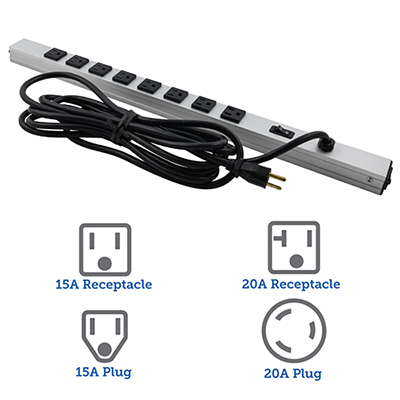
Image Source: www.racksolutions.com
Deciphering Your Power Strip’s Amp Limit
Many people wonder about the limits of their trusty power strips. These everyday items are essential for powering multiple devices from a single wall socket. But how much electrical “oomph” can they actually take? The answer lies in understanding the amperage rating, which dictates the maximum load a power strip can safely manage. Exceeding this limit is a common mistake that can lead to serious electrical issues.
What is Amperage and Why Does It Matter?
Amperage, often shortened to “amps,” is a unit of electrical current. Think of it as the flow rate of electricity. The more devices you plug in, and the more power they draw, the higher the amperage becomes. Every electrical device has a device power consumption measured in watts (W) or amps (A). To figure out the amperage a device uses, you can often find this information on the device’s label or in its manual. A simple calculation can help: Amps = Watts / Volts.
Voltage and Current: A Crucial Relationship
In your home, the standard voltage is typically 120 volts (V) in North America and 230-240V in many other parts of the world. The interplay between voltage and current is fundamental to electrical safety. A power strip is designed to safely distribute this voltage and current to multiple outlets.
Finding Your Power Strip’s Amperage Rating
The amperage rating of a power strip is usually printed on the back or bottom of the unit. Look for a label that specifies the maximum amperage. Common ratings are 10A, 13A, or 15A. This rating is the absolute maximum the power strip can handle.
The Role of the Circuit Breaker
It’s important to remember that power strips are connected to your home’s electrical system, which is protected by circuit breakers. Each circuit in your home has a circuit breaker amperage rating, typically 15A or 20A for standard outlets. If you overload a circuit, the circuit breaker will “trip,” cutting off power to prevent damage or fire. A power strip is a distribution point; it doesn’t increase the capacity of the underlying circuit.
What is Wattage vs Amperage?
While amperage is the flow of electricity, wattage is the total power being used. They are directly related. As mentioned earlier, wattage vs amperage can be calculated using the formula: Watts = Volts x Amps.
- Amps: Measures the rate of electrical flow.
- Watts: Measures the total electrical power consumed.
Knowing both helps you manage your power usage effectively. If a power strip has a 15A rating and you’re in a 120V system, its maximum wattage capacity is 1800 watts (15A x 120V).
Maximum Load: Staying Within Safe Limits
The maximum load refers to the total combined amperage of all the devices plugged into the power strip. You must ensure that the sum of the amperage drawn by all connected devices does not exceed the power strip’s amperage rating.
Calculating Your Total Power Consumption
To calculate the total amperage of your connected devices:
- Check Device Labels: Find the power consumption (in watts or amps) for each device.
- Convert to Amps (if necessary): If a device lists watts, divide watts by your home’s voltage (usually 120V) to get the amperage.
- Sum the Amperages: Add up the amperage drawn by all devices.
- Compare to Power Strip Rating: Ensure the total amperage is less than or equal to the power strip’s amperage rating.
Example:
* Laptop: 60W (approx. 0.5A at 120V)
* Desk Lamp: 40W (approx. 0.33A at 120V)
* Phone Charger: 10W (approx. 0.08A at 120V)
* Small Fan: 50W (approx. 0.42A at 120V)
Total Amperage: 0.5A + 0.33A + 0.08A + 0.42A = 1.33A
This total (1.33A) is well within the typical 10-15A limit of most power strips.
Power Outlet Capacity: The Foundation of Safety
A power strip is only as good as the power outlet capacity it’s plugged into. Your home’s electrical wiring is designed to handle a certain amount of current safely. Plugging multiple high-draw devices into a single power strip, even if the power strip itself is rated for it, could still overload the wall outlet or the circuit it’s connected to.
Understanding Extension Cord Amps
If you’re using an extension cord with a power strip, the same principles apply. Extension cords also have an extension cord amps rating. Always ensure the extension cord’s rating is equal to or greater than the power strip’s amperage rating. Using an undersized extension cord is a significant fire risk.
- Heavy-Duty Extension Cords: Often rated for 15 amps or more, suitable for high-draw appliances.
- Light-Duty Extension Cords: Typically rated for 7-10 amps, best for low-power devices like lamps or radios.
Surge Protector Amperage: More Than Just Protection
Many power strips today are also surge protector amperage units, meaning they offer protection against voltage spikes. While the surge protection features are valuable, the fundamental amperage rating still dictates how much current it can handle. A surge protector doesn’t magically increase the amperage capacity. Always check the surge protector’s label for its maximum load.
High-Amperage Devices to Be Cautious With
Some devices draw a significant amount of power. These are the ones you need to be most careful about plugging into power strips:
- Heaters: Electric space heaters are notorious power consumers, often drawing 10-15 amps.
- Hair Dryers and Curling Irons: High-wattage styling tools can draw 10-12 amps.
- Microwaves: These can pull 8-12 amps.
- Toasters and Toaster Ovens: Typically draw 8-12 amps.
- Vacuum Cleaners: Can range from 7-12 amps.
- Power Tools: Such as drills and saws, can draw 5-15 amps.
Plugging one of these high-amperage devices into a power strip already loaded with other items can easily exceed its maximum load capacity. It’s often best to plug high-draw appliances directly into a wall outlet, especially if that outlet is on a dedicated circuit.
Electrical Safety Limits: Prioritizing Your Well-being
Adhering to electrical safety limits is paramount. Overloading a power strip can lead to:
- Overheating: The wires inside the power strip and the connected devices can overheat, melting plastic and creating a fire hazard.
- Damage to Devices: Excessive current can damage the internal components of your electronics.
- Tripped Circuit Breakers: While a safety feature, constantly tripping breakers indicates you’re exceeding the capacity of your home’s electrical system.
- Fire: In severe cases, overheating can ignite materials around the power strip.
Fathoming the Consequences of Overloading
Fathoming the consequences of overloading a power strip is crucial for prevention. It’s not just about a device not working; it’s about creating a dangerous situation. The internal wiring and components of a power strip are designed for a specific current. Pushing more through them than they are rated for is like asking a small pipe to carry a river – it will eventually fail, and not gracefully.
Interpreting Power Strip Specifications
When choosing or using a power strip, pay close attention to its specifications.
Table: Common Power Strip Ratings and Their Capacities (at 120V)
| Amperage Rating | Maximum Wattage (120V) | Typical Use Cases |
|---|---|---|
| 10 Amps | 1200 Watts | Lighting, small electronics, chargers |
| 13 Amps | 1560 Watts | Standard home office equipment, entertainment systems |
| 15 Amps | 1800 Watts | Heavier loads, small appliances (with caution) |
Important Note: Always verify the amperage rating and voltage on your specific power strip and the devices you intend to connect.
When to Avoid Using a Power Strip
There are times when it’s best to bypass a power strip altogether and plug devices directly into a wall outlet. This is especially true for:
- High-Wattage Appliances: As listed previously (heaters, microwaves, hair dryers, etc.).
- Appliances with Motors: These often have a high “startup” surge of current.
- Medical Equipment: Reliability is paramount for life-support or monitoring devices.
- If the Wall Outlet is Damaged or Loose: This indicates a problem with the outlet itself, regardless of the power strip.
The Importance of a Dedicated Circuit
For high-draw appliances, a dedicated circuit is the safest solution. This means the appliance is the primary or only device drawing power from that specific circuit breaker. This ensures the circuit isn’t overloaded.
Frequently Asked Questions (FAQ)
Q1: Can I plug a space heater into a power strip?
A1: It is generally not recommended to plug high-wattage appliances like space heaters into a standard power strip, especially if the power strip is already powering other devices. Space heaters draw a lot of current (often 10-15 amps). Check both the heater’s and the power strip’s amperage rating. If the heater is close to or exceeds the power strip’s limit, plug it directly into a wall outlet on a circuit that isn’t heavily loaded.
Q2: How many devices can I plug into one power strip?
A2: The number of devices you can plug into a power strip depends on their individual device power consumption and the power strip’s amperage rating. You must sum the amperage of all devices and ensure it stays below the power strip’s maximum capacity. It’s better to be conservative.
Q3: What happens if I overload a power strip?
A3: Overloading a power strip can cause it to overheat, melt, and potentially start a fire. It can also damage your connected devices and may trip your home’s circuit breaker.
Q4: Is a surge protector different from a power strip in terms of amperage?
A4: Many surge protectors are also power strips, but their surge protection feature doesn’t change their fundamental amperage rating. The surge protector amperage limit still applies and determines the maximum load the unit can handle for continuous power delivery.
Q5: Does the voltage of my outlet affect how many amps a power strip can handle?
A5: The amperage rating of the power strip is the limit for current, regardless of voltage. However, the wattage capacity (Watts = Volts x Amps) will differ. For example, a 15A power strip will handle 1800W at 120V but 3300W at 220V. You still must not exceed the amperage limit.
Q6: Can I use a higher amperage power strip than what’s needed?
A6: Yes, it’s generally safe to use a power strip with a higher amperage rating than your devices require. For instance, using a 15A power strip for devices that only draw a total of 5A is perfectly fine. The devices will only draw the amperage they need.
Q7: What’s the difference between wattage and amperage in a power strip context?
A7: Wattage vs amperage are related but distinct. Amperage (amps) is the flow of electricity, while wattage (watts) is the total power used. A power strip’s rating is usually given in amps. You can calculate its maximum wattage capacity by multiplying its amperage rating by your home’s voltage (Amps x Volts = Watts). Both ratings are crucial for safe operation.
Q8: Are all power strips the same regarding their amperage handling?
A8: No, power strips vary significantly. Always check the label for the specific amperage rating. Some are designed for light loads (e.g., 10 amps), while others can handle heavier loads (e.g., 15 amps).
Q9: What is the typical power outlet capacity in a home?
A9: Standard power outlet capacity is dictated by the circuit breaker protecting it. Most residential circuits are 15 amps or 20 amps. A power strip’s rating should ideally not exceed the rating of the circuit it’s plugged into, and certainly not the rating of the wall outlet wiring.
Q10: Do extension cords have amp limits?
A10: Yes, every extension cord amps rating. This rating is crucial and often lower than a power strip’s. Always ensure the extension cord’s amp rating is equal to or greater than the power strip’s amperage rating and the total load. Using an undersized extension cord is a fire hazard.
By paying close attention to the amperage rating, understanding device power consumption, and respecting electrical safety limits, you can use power strips safely and effectively. Always prioritize safety over convenience to prevent potential hazards.