
Many people saw Jesus after he rose from the dead. The Bible tells us that over 500 people saw him at one time. These post-resurrection sightings are crucial to the Christian faith.
The resurrection of Jesus Christ is the cornerstone of Christianity. The New Testament Gospels and the letters of the Apostle Paul provide detailed accounts of Jesus appearing to various individuals and groups after his crucifixion and burial. These encounters, often referred to as resurrection appearances, are central to the testimonies of his followers and form the basis for the belief in his divine nature and victory over death. This exploration delves into who saw Jesus after the resurrection, examining the key witnesses and the significance of their experiences.
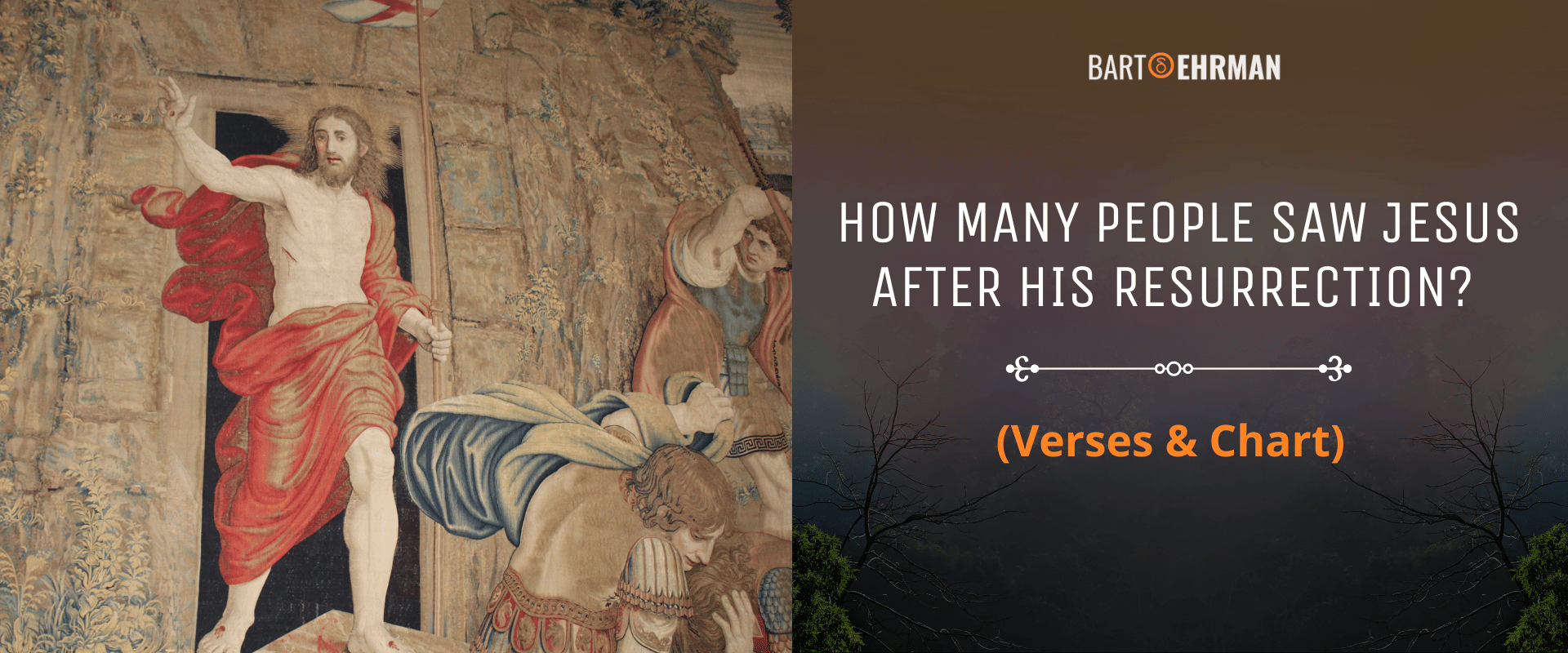
Image Source: www.bartehrman.com
The First Sightings: Grief and Disbelief
The initial hours and days following the resurrection were marked by a mix of shock, grief, and hesitant belief among Jesus’ closest followers. The tomb was found empty, a fact that initially caused confusion rather than immediate understanding of a resurrection.
Mary Magdalene Saw Jesus
One of the very first, and perhaps most pivotal, post-resurrection sightings was that of Mary Magdalene. The Gospel of John (Chapter 20) records her going to the tomb early on the first day of the week and finding the stone rolled away. Her initial reaction was grief, assuming Jesus’ body had been stolen. When she encountered Jesus, she did not recognize him at first. It was only when he spoke her name, “Mary,” that she knew it was him. Her deep emotional connection and her subsequent role as the “apostle to the apostles” highlight the profound impact of this encounter. Her testimony was crucial in alerting the other disciples.
The Women at the Tomb
Beyond Mary Magdalene, other women also visited the tomb and were among the first to witness the empty tomb and receive angelic messages. While the Gospels differ slightly on the exact sequence and who was present, it is clear that women were prominent in the earliest confirmations of the resurrection. Their accounts, though initially met with disbelief by some of the male disciples, paved the way for further encounters.
Jesus Appears to the Disciples: Doubt and Confirmation
The period following the initial discovery of the empty tomb saw Jesus appearing to his disciples, often in private settings, gradually dispelling their fears and doubts.
The Disciples Saw Jesus on the Road to Emmaus
The Gospel of Luke (Chapter 24) tells the story of two disciples walking to Emmaus. As they discussed the events of the past few days, Jesus himself joined them, but they did not recognize him. He engaged them in conversation, explaining the Scriptures concerning the Messiah. It was only when he broke bread with them that their eyes were opened, and they recognized him. This appearance is significant as it shows Jesus revealing himself through shared scripture and communion, even to those who were journeying away from Jerusalem.
Thomas’ Doubt and Belief
One of the most famous resurrection appearances addresses the issue of doubt directly. Thomas, one of the twelve disciples, was not present when Jesus first appeared to the other disciples. He famously declared, “Unless I see the nail marks in his hands and put my finger into the wounds, I will not believe” (John 20:25). A week later, Jesus appeared again, specifically addressing Thomas’ doubt. He invited Thomas to touch his wounds, saying, “Put your finger here; see my hands. Reach out your hand and put it into my side. Stop doubting and believe.” Thomas’ response, “My Lord and my God!” signifies his complete conviction. This appearance is critical because it validates the reality of the resurrection for those who require tangible proof.
Peter Saw Jesus
The Apostle Peter, who had famously denied Jesus three times, also had a personal and restorative encounter with the resurrected Christ. While not detailed as extensively as some other appearances, ancient tradition and the testimony of other disciples point to Peter seeing Jesus. This encounter is implied in the Gospel accounts and is crucial for Peter’s re-affirmation and subsequent leadership within the early church. The resurrected Jesus prioritizes restoring those who had fallen.
Jesus Appears to the Eleven and Others
Multiple Gospel accounts describe Jesus appearing to the assembled disciples, including the eleven apostles. These appearances often occurred behind locked doors, demonstrating Jesus’ transformed, resurrected body. The disciples’ initial fear and astonishment gradually turned into joy and affirmation as they saw and spoke with him. These group appearances served to strengthen their faith and equip them for their mission.
Broader Sightings and the Great Commission
As the days turned into weeks, Jesus continued to appear to larger groups, culminating in specific instructions and a mandate for his followers.
The Mount of Olives and the Ascension Accounts
The Gospel of Luke and the Book of Acts both provide accounts of Jesus’ ascension into heaven. He met with his disciples on the Mount of Olives and, after giving them final instructions and a promise of the Holy Spirit, he was taken up into heaven while they watched. This event marked the transition from Jesus’ physical presence on earth to his ongoing spiritual presence and intercession. The ascension accounts are crucial as they signify the completion of his earthly ministry and the authorization of his followers to carry on his work.
The Great Commission
During these post-resurrection appearances, Jesus delivered what is known as the Great Commission. This instruction, most famously recorded in Matthew 28:18-20, is a central command for all Christians: “Go therefore and make disciples of all nations, baptizing them in the name of the Father and of the Son and of the Holy Spirit, teaching them to observe all that I have commanded you. And behold, I am with you always, to the end of the age.” This commission was given after his resurrection, underscoring that the mandate to spread the Gospel is rooted in his victory over death.
Paul’s Encounter with Jesus
The Apostle Paul, originally known as Saul of Tarsus, was a fierce persecutor of early Christians. His transformation is one of the most dramatic testimonies to the reality of Jesus’ post-resurrection presence.
Paul’s Encounter with Jesus on the Road to Damascus
While Paul did not see Jesus in the same way the disciples did during his earthly ministry or immediately after the resurrection, he had a profound, life-altering encounter with the resurrected Christ on the road to Damascus (Acts 9). As Saul was on his way to persecute Christians, a blinding light from heaven flashed around him. He fell to the ground and heard a voice saying, “Saul, Saul, why do you persecute me?” When he asked who it was, the voice replied, “I am Jesus, whom you are persecuting.” This celestial encounter led to Saul’s conversion and his subsequent role as a pivotal figure in spreading Christianity. Paul himself considered this encounter as seeing the Lord, stating in 1 Corinthians 15:8, “Last of all, as to untimely born, he appeared also to me.” This makes his testimony a powerful witness to the resurrected Christ.
Number of Witnesses: A Significant Crowd
While pinpointing an exact number is challenging due to the nature of the biblical narrative, we can identify key groups and individuals who saw Jesus after the resurrection.
The 500 Witnesses
Perhaps the most striking quantitative claim comes from Paul’s first letter to the Corinthians (Chapter 15). He writes, “And he appeared to more than five hundred brothers at one time, most of whom are still alive, though some have fallen asleep.” This statement refers to a significant gathering where Jesus appeared to a large crowd of believers. This mass appearance is a powerful testament to the public nature of at least some of the resurrection appearances, reinforcing the claim that Jesus’ victory was not a private or imagined event.
Summary of Key Witness Groups
Here is a summary of the main groups and individuals who are recorded as having seen the resurrected Jesus:
| Witness Group/Individual | Biblical Reference (Primary) | Significance |
|---|---|---|
| Mary Magdalene | John 20:11-18 | First to see Jesus, receives the initial commission to tell the disciples. |
| Other Women (e.g., Joanna, Mary the mother of James) | Luke 24:1-10, Matthew 28:1-10 | Confirmed the empty tomb and angelic messages. |
| Two Disciples on the Road to Emmaus | Luke 24:13-35 | Jesus revealed himself through scripture and breaking bread; accounts for post-resurrection sightings. |
| Thomas | John 20:26-29 | Confronted his doubt, leading to a confession of faith. |
| The Disciples (as a group, excluding Thomas initially) | John 20:19-23, Luke 24:36-43 | Demonstrated Jesus’ resurrected body, dispelled fear, received the Holy Spirit. |
| Peter | Implied in John 21:1-19, 1 Corinthians 15:5 | Personal encounter, restorative. |
| More than 500 Brothers | 1 Corinthians 15:6 | A large, public appearance, significant for the breadth of witnesses. |
| James (Jesus’ brother) | 1 Corinthians 15:7 | A personal appearance to a key leader in the early church. |
| All the Apostles (as a final group) | Acts 1:3-9, 1 Corinthians 15:7 | Final appearances before ascension, commission and promise of the Spirit. |
| Paul (Saul of Tarsus) | Acts 9:1-19, 1 Corinthians 15:8 | A transformational encounter with the resurrected Christ. |
The Impact of the Resurrection Appearances
The post-resurrection sightings were not merely isolated events; they had profound consequences for the disciples and the nascent Christian movement.
Transformation of the Disciples
The despair and fear that gripped Jesus’ followers after his crucifixion were replaced with courage, conviction, and an unshakeable zeal. The disciples, who had initially scattered, became bold preachers of the resurrection. Their willingness to suffer and even die for their belief in the resurrected Christ is a testament to the transformative power of these appearances. They went from hiding to proclaiming Jesus publicly.
Foundation of Christian Theology
The resurrection appearances are fundamental to Christian theology. They affirm Jesus’ divine identity, his victory over sin and death, and the validity of his teachings. The belief that Jesus was raised and seen by numerous witnesses is the bedrock upon which the entire Christian faith is built. The resurrection appearances are not peripheral; they are central.
The Spread of the Gospel
The resurrected Jesus’ commissioning of his followers, the Great Commission, directly fueled the expansion of Christianity. Empowered by the Holy Spirit and convinced by the reality of the resurrection, the apostles and early believers carried the message of Jesus throughout the known world. The numerous resurrection sightings provided them with the unassailable authority and message to share.
Examining the Evidence for Post-Resurrection Sightings
Historians and theologians have extensively debated the evidence for these appearances. The primary sources are the New Testament writings, particularly the Gospels and Paul’s letters.
The Gospels as Primary Sources
The four Gospels (Matthew, Mark, Luke, and John) provide detailed accounts of Jesus’ life, death, and resurrection. While there are variations in the narratives, they consistently report that Jesus appeared to many individuals and groups after his resurrection. These variations are often seen by scholars as evidence of independent witness accounts, rather than a coordinated fabrication.
Paul’s Testimony
Paul’s letters, written within decades of Jesus’ crucifixion, are considered some of the earliest Christian documents. His explicit mention of the appearance to over 500 people is a crucial piece of evidence, as he was writing to a community that could verify his claims. His own dramatic conversion, stemming from a post-resurrection encounter, further bolsters the credibility of these events.
Corroborating Accounts
The consistency across different Gospel writers, who likely drew on various sources, strengthens the historical case for the resurrection appearances. The fact that women, often less credible as witnesses in the ancient world, were the first to see and report the resurrection, adds another layer of persuasive evidence.
Frequently Asked Questions About Jesus’ Post-Resurrection Sightings
Q1: How many people in total saw Jesus after he rose?
A1: The Bible mentions specific groups and individuals, with the Apostle Paul stating that over 500 people saw Jesus at one time. While an exact total number is not provided, the evidence points to dozens, if not hundreds, of eyewitnesses across various post-resurrection sightings.
Q2: Were the post-resurrection sightings different from his earthly ministry appearances?
A2: Yes, the resurrection appearances often involved Jesus appearing and disappearing suddenly, or being unrecognized initially, indicating a transformed, glorified body. His physical presence was real, but it transcended ordinary human limitations.
Q3: Why is Mary Magdalene’s sighting so important?
A3: Mary Magdalene was among the first to witness the empty tomb and the first to see the resurrected Jesus. Her encounter was deeply personal, and Jesus commissioned her to tell the disciples, earning her the title “apostle to the apostles.”
Q4: Did Jesus appear to his enemies after the resurrection?
A4: The New Testament primarily focuses on appearances to his followers. There is no record of him appearing to his primary antagonists like the chief priests or Pontius Pilate after the resurrection.
Q5: What is the significance of the Great Commission in relation to the resurrection appearances?
A5: The Great Commission, delivered during one of the post-resurrection appearances, is the mandate given by Jesus for his followers to spread the Gospel. It highlights that the mission of Christianity is directly linked to and empowered by his victory over death, demonstrated by the resurrection.
Q6: How credible are the biblical accounts of these appearances?
A6: The biblical accounts are the primary historical sources. Historians and theologians analyze them for internal consistency, external corroboration (where possible), and the nature of the witness testimony. The early and widespread nature of these accounts, coupled with the radical transformation of the disciples, is considered strong evidence by many.
Q7: What does Paul’s encounter with Jesus mean for the resurrection testimonies?
A7: Paul’s encounter on the road to Damascus, leading to his conversion from a persecutor to an apostle, is a powerful testament. He himself considered it a genuine appearance of the resurrected Lord and his writings are crucial early evidence for the resurrection and its witnesses.
The resurrection appearances of Jesus are a profound testament to the core beliefs of Christianity. From the tender encounter with Mary Magdalene to the definitive moment of Thomas’ belief, and the momentous mass sighting of over 500 individuals, these post-resurrection sightings offer a rich tapestry of evidence for a transformed Christ. These encounters were not mere visions but deeply impactful events that reshaped the lives of his followers, empowered them to spread the Gospel, and ultimately laid the foundation for one of the world’s major religions. The Great Commission, given in the context of these appearances, continues to guide believers today, rooted in the historical reality of Jesus’ victory over death.