
A typical power strip can handle a maximum of 1500 to 1875 watts in the United States, assuming it’s connected to a standard 15-amp or 20-amp household circuit. However, the exact power strip wattage limit depends on several factors, including its own design and the electrical circuit it’s plugged into. Overloading a power strip can lead to overheating, potential fire hazards, and damage to connected devices.
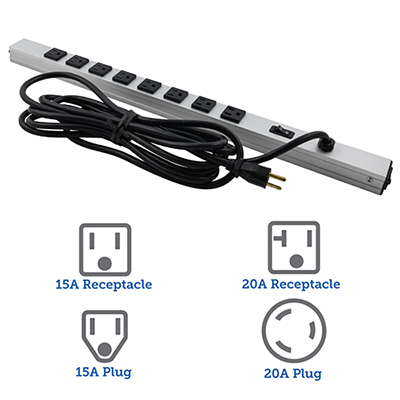
Image Source: www.racksolutions.com
Deciphering Power Strip Electrical Limits
It’s crucial to understand that a power strip isn’t just a collection of outlets; it’s a component within a larger electrical system. Knowing the power strip electrical limits is vital for safety and to ensure your electronics function correctly. This article will delve into the intricacies of power strip wattage, helping you make informed decisions about how much power your power strip can safely deliver.
The Backbone: Electrical Circuits and Amperage
Household electrical circuits are designed with specific limitations. In the US, standard circuits are typically rated at 15 amps or 20 amps. These ratings dictate the maximum amount of electrical current (measured in amperes, or amps) that can flow through the circuit safely before a breaker trips or a fuse blows.
Key electrical terms to grasp:
- Voltage (V): The electrical “pressure” that pushes current through a circuit. Standard household voltage in the US is 120 volts.
- Current (A): The flow of electrical charge. This is measured in amps.
- Power (W): The rate at which electrical energy is transferred or used. Power is calculated by multiplying voltage by current (Watts = Volts × Amps).
Calculating Power Strip Capacity
The maximum power strip capacity is directly tied to the amperage rating of the circuit it’s connected to and the power strip’s own internal wiring and design. Most consumer-grade power strips are designed to work with standard household circuits.
Formula for calculating maximum wattage:
Maximum Watts = Circuit Amps × Circuit Voltage
For a 15-amp circuit at 120 volts:
15 Amps × 120 Volts = 1800 Watts
For a 20-amp circuit at 120 volts:
20 Amps × 120 Volts = 2400 Watts
The Role of the Power Strip Wattage Limit
While a circuit might be rated for 15 amps (1800 watts), a power strip itself often has its own power strip wattage limit. This limit is usually printed on the power strip itself, often near the plug or on the underside. It’s a good practice to always check this rating. Many common power strips are rated for 1500 watts or 1875 watts.
Why the Discrepancy?
Manufacturers often de-rate power strips slightly below the circuit’s maximum capacity for a safety margin. This is to account for:
- Heat Dissipation: Even within limits, power flow generates heat. A buffer ensures the power strip doesn’t overheat.
- Component Limitations: The internal wiring, outlets, and surge protection components have their own tolerances.
- Surge Protection: If the power strip includes surge protection, the surge suppression circuitry might have its own limitations on how much power it can handle in a surge event.
The Power Strip Amp Rating: A Critical Factor
Beyond wattage, the power strip amp rating is equally important. This rating indicates the maximum current the power strip itself can safely handle. If your connected devices draw more amps than the power strip is rated for, even if the total wattage is within limits, you risk overheating the power strip.
Example:
A power strip rated for 15 amps is connected to a 15-amp circuit. If you plug in multiple devices that, in total, draw 14 amps, you are nearing the power strip’s limit and the circuit’s limit.
How Much Power Can a Power Strip Deliver?
The how much power can a power strip deliver is determined by the lesser of two values: the circuit’s capacity or the power strip’s own maximum capacity.
Scenario 1: Power Strip is the Limiting Factor
- Circuit: 20 Amp (2400 Watts)
- Power Strip: 1500 Watt rating
In this case, the power strip can only deliver a maximum of 1500 watts, even though the circuit could theoretically handle more.
Scenario 2: Circuit is the Limiting Factor
- Circuit: 15 Amp (1800 Watts)
- Power Strip: 1875 Watt rating
Here, the power strip can deliver up to its rated 1875 watts, but it’s limited by the circuit to 1800 watts.
Fathoming Total Wattage for Power Strip Use
To operate safely, you need to calculate the total wattage for power strip use by summing the wattage of all devices plugged into it.
How to find a device’s wattage:
- Check the device label: Most electronic devices have a label indicating their power consumption. This might be in watts (W) or amps (A).
- If only amps are listed: Multiply the amps by the voltage (120V in the US) to find the wattage. For example, a device drawing 1 amp uses 1 amp × 120 volts = 120 watts.
Example Calculation:
Let’s say you want to plug the following into a power strip rated for 1800 watts:
- Laptop: 65 watts
- Monitor: 30 watts
- Desk Lamp: 40 watts
- Phone Charger: 10 watts
- Small Fan: 50 watts
Total Wattage = 65 + 30 + 40 + 10 + 50 = 195 watts
This total (195 watts) is well within the power strip’s 1800-watt limit.
Dangers of Overloading a Power Strip
Overloading a power strip is a common mistake that can have serious consequences. When the total power demand exceeds the power strip’s or the circuit’s capacity, several things can happen.
The Chain Reaction of Overload
- Overheating: The primary issue is heat. As more current flows through the power strip’s wiring and components than they are designed to handle, resistance causes them to heat up. This can melt the plastic casing, damage internal components, and even ignite nearby flammable materials.
- Tripped Breakers/Blown Fuses: Electrical circuits have built-in safety mechanisms. If the total current draw exceeds the circuit’s rating (e.g., 15 amps), the power strip circuit breaker (if it has one) or the main circuit breaker for that room will trip, cutting off power to prevent damage or fire.
- Damage to Devices: Fluctuations in power or surges caused by an overloaded system can damage sensitive electronics plugged into the power strip.
- Fire Hazard: This is the most severe risk. Overheated wires and components can melt insulation, creating short circuits that can spark and ignite fires.
Identifying Power-Hungry Devices
Some appliances and electronics consume significantly more power than others. Always consider these when planning your power strip usage:
- High-Wattage Appliances: Space heaters, hair dryers, toasters, coffee makers, microwaves, vacuum cleaners, and power tools are notorious power consumers.
- Devices with Heating Elements: Anything that heats up (like toasters or kettles) typically draws a lot of power.
- Motorized Devices: Appliances with motors, like blenders or vacuums, can have high startup current draws, which momentarily increases their wattage demand.
Table: Typical Wattage Consumption of Common Household Devices
| Device | Typical Wattage (Watts) | Amps (at 120V) | Notes |
|---|---|---|---|
| Laptop | 20 – 65 | 0.17 – 0.54 | Varies with model and usage |
| Desktop Computer | 50 – 300 | 0.42 – 2.5 | Varies significantly |
| Monitor | 15 – 50 | 0.13 – 0.42 | LED monitors are more efficient |
| LED Desk Lamp | 5 – 15 | 0.04 – 0.13 | |
| Incandescent Bulb | 60 – 100 | 0.5 – 0.83 | Inefficient; consider LED replacements |
| LED Bulb | 5 – 15 | 0.04 – 0.13 | |
| Smartphone Charger | 5 – 20 | 0.04 – 0.17 | |
| TV (LED/LCD) | 50 – 150 | 0.42 – 1.25 | Larger screens use more power |
| Gaming Console | 100 – 250 | 0.83 – 2.08 | Varies with game complexity |
| Hair Dryer | 1200 – 1875 | 10 – 15.6 | High wattage; use with caution |
| Toaster | 800 – 1500 | 6.67 – 12.5 | High wattage; use with caution |
| Microwave | 700 – 1500 | 5.83 – 12.5 | High wattage; use with caution |
| Coffee Maker | 600 – 1200 | 5 – 10 | |
| Space Heater | 750 – 1500 | 6.25 – 12.5 | High wattage; use with caution |
| Vacuum Cleaner | 600 – 1500 | 5 – 12.5 | Varies by motor power |
Important Note: Devices like space heaters, hair dryers, toasters, and microwaves are often best plugged directly into a wall outlet to avoid overloading a power strip, especially if the power strip has a lower wattage rating or is already powering other devices.
Surge Protector Wattage: An Added Layer of Protection
Many power strips come with surge protection. A surge protector wattage rating refers to the amount of energy the surge protector can absorb during a power surge without failing. This is measured in joules. While joule ratings are important for surge protection effectiveness, the power strip wattage limit and power strip amp rating still dictate how much power the strip can safely deliver continuously.
How Surge Protection Works
Surge protectors use components like Metal Oxide Varistors (MOVs) to divert excess voltage away from your connected electronics and into the ground wire. When a surge occurs, the MOV’s resistance drops, allowing the excess electricity to flow through it.
Surge Protector Wattage vs. Power Strip Wattage
It’s crucial to differentiate:
- Power Strip Wattage Limit: The maximum continuous power (watts) the strip can safely pass through from the wall to your devices.
- Surge Protector Joules Rating: The amount of energy the surge protection circuitry can absorb in a single surge event or over its lifespan.
A high joule rating means better surge protection, but it doesn’t increase the power strip power rating for everyday use. You still need to stay within the strip’s continuous wattage and amperage limits.
Interpreting Power Strip Markings and Ratings
Manufacturers provide essential information on power strips to guide users. Locating and deciphering these ratings is key to safe operation.
Where to Find the Ratings
- On the Strip Itself: Look for labels printed directly on the power strip casing, usually on the bottom or back.
- On the Packaging: The original box or any accompanying manual should contain detailed specifications.
- Near the Plug: Sometimes, the electrical rating is printed close to the power cord’s plug.
Key Markings to Look For:
- Wattage Limit: Often stated as “Max Wattage: 1800W” or similar.
- Amperage Rating: May be expressed as “15A,” “13A,” etc. Remember that 15 amps at 120 volts equals 1800 watts.
- Voltage: Typically 120V for US models.
- UL Listing: A “UL Listed” mark (or similar certifications like ETL or CSA) indicates the product has been tested and meets safety standards. This is a crucial safety indicator.
- Surge Protection Ratings: Joules (e.g., 1000 Joules, 2000 Joules).
Power Strip Power Rating Explained
The power strip power rating is a general term that encompasses both its wattage limit and amperage rating. It’s the overall measure of how much electrical load the power strip can safely manage. Always prioritize the lowest rating if different figures seem to apply. For instance, if a power strip has a 15A rating but a label says “Max 1500 Watts,” you should adhere to the 1500-watt limit, as it translates to 12.5 amps (1500W / 120V = 12.5A).
Maintaining Safe Power Strip Usage
Safe usage involves more than just staying within the wattage limits. Proper care and placement are also important.
Best Practices for Power Strip Use:
- Check the Rating: Always verify the power strip’s power strip wattage limit and power strip amp rating before plugging anything in.
- Calculate Total Load: Sum the wattage of all devices you intend to plug into the power strip.
- Avoid High-Wattage Devices: Do not plug high-draw appliances (heaters, hair dryers, toasters) into standard power strips, especially if the power strip is already in use. Use dedicated wall outlets for these.
- Don’t Chain Power Strips: Plugging one power strip into another (daisy-chaining) can create a bottleneck, increase resistance, and significantly raise the risk of overheating. This is a major fire hazard.
- Inspect Regularly: Periodically check power strips for signs of damage, such as melted plastic, frayed cords, or loose outlets. Replace any damaged power strips immediately.
- Ensure Proper Ventilation: Don’t cover power strips with blankets, rugs, or anything that can trap heat. Ensure adequate airflow around the strip.
- Use the Right Type: For areas prone to moisture, consider a power strip specifically designed for damp environments.
- Connect to a Grounded Outlet: Always plug your power strip into a properly grounded three-prong outlet. The ground connection is essential for surge protection and safety.
The Power Strip Circuit Breaker: Your Safety Net
Some higher-quality power strips come with a built-in power strip circuit breaker. This is a small, often resettable switch. If the power strip is overloaded, this breaker will “trip,” interrupting the flow of electricity to prevent damage. After identifying and removing the cause of the overload, you can usually reset the breaker by pressing the button. This feature adds an extra layer of protection, but it’s still crucial not to intentionally overload the strip.
Common Scenarios and Troubleshooting
Let’s address some typical situations and questions users have regarding power strip wattage.
Scenario: My Power Strip Has No Wattage Rating
If a power strip lacks a clear wattage rating, assume it’s designed for low-power devices like computers, monitors, and chargers. It’s safest to assume it has a power strip wattage limit of around 1500 watts (which corresponds to 12.5 amps at 120V). For anything consuming more than a few hundred watts in total, it’s best to use a dedicated wall outlet.
Scenario: What If My Power Strip Feels Warm?
A slightly warm power strip might be normal if it’s powering several devices, especially if they are drawing moderate power. However, if it feels hot to the touch, or if the casing is discolored or melting, unplug it immediately. This is a clear sign of overloading a power strip or a fault within the strip itself.
Troubleshooting a Tripped Breaker
If the power to your outlets suddenly cuts off, and you suspect it’s related to a power strip:
- Unplug the Power Strip: Disconnect the power strip from the wall outlet.
- Unplug Devices: Disconnect all devices from the power strip.
- Check the Power Strip: Inspect the power strip for any visible damage.
- Reset the Circuit Breaker: Go to your home’s electrical panel and find the tripped breaker. Flip it completely off, then back on.
- Plug in Devices Gradually: Reconnect devices to the power strip one by one, monitoring the power strip for any signs of overheating. Reconnect the power strip to the wall. If the breaker trips again with only a few low-wattage devices plugged in, the power strip or the circuit itself may have an issue.
Frequently Asked Questions (FAQ)
Q1: Can I plug a space heater into a power strip?
A1: It’s generally not recommended to plug high-wattage devices like space heaters into a standard power strip. Most space heaters draw 1500 watts or more, which is often the maximum capacity of a common power strip. Plugging a space heater into a power strip, especially one already powering other devices, can easily cause overloading a power strip and create a fire hazard. Always plug space heaters directly into a wall outlet.
Q2: What is the power strip amp rating I should look for?
A2: For general use, a power strip with a 15-amp rating is common and suitable for most home and office electronics. This typically corresponds to an 1800-watt capacity at 120 volts. If you plan to power more demanding equipment, consider power strips with higher amperage ratings or specialized heavy-duty power strips. Always ensure the circuit you’re plugging into can support the amperage.
Q3: How do I calculate the total wattage for power strip use?
A3: To calculate the total wattage for power strip use, find the wattage of each device you intend to plug in. This information is usually on a label on the device itself. If only amperage is listed, multiply the amps by 120 (for US voltage) to get the wattage. Add up the wattage of all devices. For example, if you have a laptop (65W), monitor (30W), and desk lamp (40W), the total wattage is 65 + 30 + 40 = 135 watts.
Q4: What happens if I exceed the maximum power strip capacity?
A4: Exceeding the maximum power strip capacity can lead to the power strip overheating, melting its plastic housing, and potentially causing a fire. It can also trip the power strip circuit breaker if one is present, or the main circuit breaker for that outlet, cutting off power to prevent damage.
Q5: Does surge protector wattage matter for everyday use?
A5: The surge protector wattage (joule rating) is about protecting your devices from sudden voltage spikes, not about the continuous power the strip can deliver. For everyday use, the power strip wattage limit and power strip amp rating are more critical. A good surge protector has both a high joule rating and meets the wattage/amperage requirements for your devices.
Q6: Can I plug a high-power device like a microwave into a power strip?
A6: Microwaves draw a significant amount of power (often 700-1500 watts). While some power strips might have a rating high enough to theoretically handle it, it’s strongly advised to plug microwaves directly into a dedicated wall outlet. This prevents overloading a power strip and ensures the appliance receives a stable power supply, reducing the risk of tripping breakers or causing overheating.
By paying close attention to these details and adhering to safe practices, you can ensure your power strips operate effectively and safely, protecting both your valuable electronics and your home.