
What is a band saw blade? A band saw blade is a continuous, flexible metal strip with sharp teeth along one edge, used for cutting various materials like wood, metal, and plastic. How do you measure a band saw blade? Measuring a band saw blade accurately is crucial for ensuring proper fit, performance, and safety. This involves determining its length, width, thickness, and tooth characteristics.
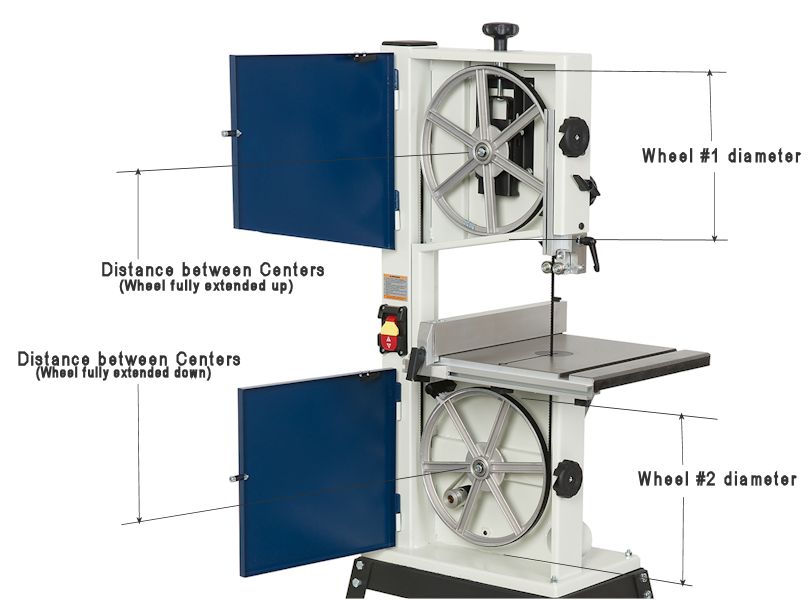
Image Source: www.bandsawbladecenter.com
The Importance of Accurate Band Saw Blade Measurements
Getting the right measurements for your band saw blade isn’t just about avoiding frustration; it’s about maximizing efficiency and ensuring safety. A blade that’s too long or too short won’t fit correctly on the wheels, leading to poor tracking and potential damage to the saw or the blade itself. Similarly, the wrong width or thickness can affect the type of cuts you can make and the overall durability of the blade. Understanding these measurements empowers you to select the correct replacement blades and to troubleshoot any cutting issues you might encounter.
Decoding Band Saw Blade Dimensions: A Detailed Look
When you need to replace a band saw blade or simply want to understand its specifications better, a few key measurements come into play. These dimensions dictate how the blade will interact with your band saw and the material you’re cutting.
Measuring Band Saw Blade Length
The band saw blade length is perhaps the most critical measurement. A blade that’s too short will not loop around the band saw’s wheels, while one that’s too long will be impossible to tension correctly.
How to Measure Band Saw Blade Length:
- Safety First: Always ensure the band saw is unplugged and the blade is completely stopped.
- Uncouple the Blade: Most band saw blades have a welded joint. You’ll need to carefully uncouple the blade from its welded loop. Some older saws might have blades that use hooks and pins, but welding is standard today. You can cut the blade at the weld point with a metal hacksaw or an angle grinder. Be cautious of sharp edges.
- Lay it Flat: Carefully uncoil the blade and lay it flat on a clean, level surface. Try to lay it in a straight line, avoiding kinks or bends as much as possible.
- Measure the Total Length: Using a measuring tape, measure the entire length of the blade from tip to tip of the teeth on one end to the tip to tip of the teeth on the other end. Make sure the tape measure follows the curve of the blade.
- Record the Measurement: Note down the length in inches or millimeters, depending on your saw’s requirements.
Pro Tip: Your band saw’s manual is the best resource for the recommended blade length. If you’ve lost the manual or the original blade, measuring the old one is the way to go.
Determining Band Saw Blade Width
The band saw blade width refers to the measurement across the blade from one edge to the other, perpendicular to the cutting edge. This dimension significantly impacts the type of cuts you can achieve.
How to Measure Band Saw Blade Width:
- Lay the Blade Flat: As with length, lay the blade flat on a stable surface.
- Use a Caliper or Ruler: A metal ruler or, for greater accuracy, a caliper is ideal.
- Measure Across the Blade: Place the ruler or caliper edge perpendicular to the length of the blade, measuring from the smooth back edge to the cutting edge.
- Record the Width: Note the measurement in inches or millimeters. Common widths range from 1/8 inch for intricate scrollwork to 1 inch or more for resawing thick lumber.
Why Width Matters:
* Narrow Blades (e.g., 1/8″ to 1/2″): Best for curved cuts and tight radii.
* Medium Blades (e.g., 1/2″ to 3/4″): Versatile for general-purpose cutting and resawing.
* Wide Blades (e.g., 3/4″ to 1″ or wider): Ideal for straight-line ripping and resawing, providing stability and straighter cuts.
Gauging Band Saw Blade Thickness
Band saw blade thickness, also known as gauge, is the measurement of the metal itself, typically measured on the back (non-toothed edge) of the blade. While often less critical for immediate replacement than length or width, thickness affects blade stiffness and durability.
How to Measure Band Saw Blade Thickness:
- Lay the Blade Flat: Ensure the blade is laid out straight.
- Use a Precision Tool: A caliper or a micrometer will give you the most accurate reading.
- Measure the Back of the Blade: Take the measurement on the flat, non-toothed side of the blade.
- Record the Thickness: Note this measurement, usually in thousandths of an inch or millimeters.
Impact of Thickness:
* Thicker blades are generally more rigid and can withstand higher tension.
* Thinner blades are more flexible, allowing for tighter turns, but may be less stable at high speeds or under heavy load.
Interpreting Tooth Characteristics: TPI and Tooth Pitch
The teeth of a band saw blade are its workhorses, and their configuration is described by two key metrics: Tooth Per Inch (TPI) and Tooth Pitch.
Fathoming Band Saw Blade TPI (Tooth Per Inch)
Band saw blade TPI refers to the number of teeth present within a one-inch segment of the blade. This is a direct indicator of how fine or coarse the cut will be.
How to Measure Band Saw Blade TPI:
- Select a One-Inch Section: Identify a one-inch section along the blade’s length, preferably on a flat, straight part.
- Count the Teeth: Carefully count the number of teeth within that one-inch section. Be precise, ensuring you start and end at a tooth tip.
- Record the TPI: Note the number of teeth per inch.
TPI and Cutting:
* High TPI (e.g., 14-32 TPI): Produces smoother, finer cuts, suitable for thin materials, veneers, hardwoods, and metal. Fewer teeth mean less material removed per pass, resulting in a cleaner finish and less dust.
* Low TPI (e.g., 2-6 TPI): Results in faster, coarser cuts, ideal for thick lumber, softwoods, and general-purpose cutting where speed is more important than finish. More teeth remove more material per pass.
Deciphering Band Saw Blade Tooth Pitch
Band saw blade tooth pitch is essentially the same as TPI but often used interchangeably. It’s the distance between the tips of two adjacent teeth. So, a blade with 6 TPI has a tooth pitch of approximately 1/6th of an inch.
How to Measure Band Saw Blade Tooth Pitch:
- Measure from Tooth Tip to Tooth Tip: Take a measuring tape and measure the distance from the tip of one tooth to the tip of the very next tooth.
- Record the Pitch: This measurement is the tooth pitch.
Relationship to TPI:
* Tooth Pitch = 1 / TPI
* Example: A blade with 6 TPI has a tooth pitch of 1/6 inch (approx. 0.167 inches).
* Example: A blade with 14 TPI has a tooth pitch of 1/14 inch (approx. 0.071 inches).
Examining the Band Saw Blade Weld
The band saw blade weld is where the two ends of the blade are joined together to form a continuous loop. A good weld is strong, smooth, and doesn’t interfere with the band saw’s wheels or the cutting process.
Inspecting the Band Saw Blade Weld:
- Visual Inspection: Look for any cracks, porosity (small holes), or unevenness in the weld. A well-executed weld will be smooth and appear as a single, continuous piece of metal.
- Feel the Weld: Gently run your finger (with caution, as there might be slight burrs) over the weld. It should feel relatively smooth and flush with the rest of the blade.
- Check for Width Consistency: Ensure the weld doesn’t significantly widen or narrow the blade at that point.
Significance of the Weld: A faulty weld can be a point of weakness, leading to blade breakage or an uneven cut. When purchasing replacement blades, ensure they come with a professionally done weld. If you’re welding your own blades, use a specialized band saw blade welder and follow recommended procedures.
Understanding Band Saw Blade Kerf
The band saw blade kerf is the width of the cut made by the blade. It’s determined by the thickness of the blade and the set of its teeth.
What Determines Kerf:
* Blade Thickness: Thicker blades generally produce a wider kerf.
* Tooth Set: The outward bend of the teeth on either side of the blade. A more aggressive tooth set will create a wider kerf.
Measuring Kerf (Indirectly): You don’t typically “measure” the kerf directly on the blade itself in the same way you measure length or width. Instead, you observe the width of the cut the blade makes in material. However, the width of the blade and the tooth set are the factors that determine the kerf.
Why Kerf Matters:
* Material Waste: A wider kerf removes more material, which can be an issue when cutting expensive materials or when making very fine cuts where material preservation is key.
* Blade Binding: A kerf that is too narrow for the material thickness or type can lead to the blade binding or overheating.
* Blade Stability: Wider blades and tooth sets are designed to create a kerf that helps prevent the blade from binding in the cut.
Investigating Band Saw Blade Gullet
The band saw blade gullet is the space or notch between adjacent teeth. This space is crucial for clearing sawdust and chips from the cut.
Visualizing the Gullet:
* Look at the teeth and the space immediately behind them. This concave area is the gullet.
How Gullet Size Affects Cutting:
* Deep Gullets: Found on blades with lower TPI and are designed for fast material removal. They effectively clear large amounts of sawdust and chips, preventing the blade from clogging, especially when cutting softwoods or thick materials.
* Shallow Gullets: Found on blades with higher TPI. They remove less material per revolution, leading to finer finishes and are better suited for harder materials or thinner stock where clogging is less of a concern.
Factors Influencing Band Saw Blade Material
The band saw blade material plays a significant role in its cutting performance, durability, and cost. Different materials are suited for different applications.
Common Band Saw Blade Materials:
- Carbon Steel: The most common and affordable material. It’s flexible and durable but can lose its edge relatively quickly, especially when cutting hard materials or at high speeds. Best for general woodworking and softer materials.
- High-Speed Steel (HSS): More durable and can hold an edge longer than carbon steel, especially at higher temperatures. HSS blades are good for cutting harder woods, non-ferrous metals, and plastics. They are more brittle than carbon steel.
- Bi-Metal: A combination of carbon steel or alloy steel backing with an HSS or other wear-resistant alloy cutting edge. Bi-metal blades offer an excellent balance of flexibility, toughness, and edge retention. They are ideal for cutting metal, dense hardwoods, and demanding applications.
- Carbide-Tipped: These blades have small carbide inserts brazed onto the teeth. Carbide offers superior hardness and wear resistance, allowing for exceptionally long life and the ability to cut very hard materials or perform high-volume production cutting. They are the most expensive but offer the best performance in demanding scenarios.
When selecting a blade, consider the material you’ll be cutting and the desired cutting speed and finish.
Optimizing Band Saw Blade Tension
Proper band saw blade tension is vital for accurate cutting and blade longevity. Too little tension, and the blade will wander and produce inaccurate cuts. Too much tension, and you risk premature blade breakage or damage to the saw’s components.
How to Achieve Proper Blade Tension:
- Consult Your Manual: The most accurate way to set tension is by referring to your band saw’s manual. Manufacturers specify the correct tension range for their machines and blade widths.
- Tension Gauge: Many band saws have a built-in tension indicator or scale.
- The “Twist” Test (Approximate): For a general idea (use with caution and always prioritize your manual or a gauge), you can try the twist test:
- With the saw unplugged, gently push the blade towards you with your thumb in the middle of its unsupported length.
- Try to twist the blade about 45 degrees. If it twists too easily, it’s likely too loose. If it resists twisting significantly or feels like it might snap, it’s probably too tight.
- Important Note: This test is subjective and varies with blade width and material. A dedicated tension gauge is far more reliable.
Factors Affecting Tension:
* Blade Width: Wider blades generally require higher tension than narrower blades.
* Blade Material: HSS and bi-metal blades can often handle higher tension than carbon steel blades.
* Saw Design: Different band saws are designed to accommodate different tension ranges.
Tools for Accurate Band Saw Blade Measurement
Having the right tools makes all the difference when measuring your band saw blade.
Essential Measurement Tools:
- Measuring Tape: For basic length measurements. Metal tapes are more durable.
- Calipers (Vernier or Digital): Essential for precise measurements of blade width and thickness.
- Micrometer: For highly accurate thickness measurements, especially for specialized blades.
- Ruler (Metal): A sturdy metal ruler can substitute for calipers for width measurements if precision isn’t paramount.
- Magnifying Glass: Useful for clearly counting teeth for TPI or examining the weld.
- Marker Pen: To mark the weld point if you need to cut the blade for measurement.
Common Pitfalls to Avoid When Measuring Band Saw Blades
Even with the right tools, mistakes can happen. Be aware of these common errors:
- Not Unplugging the Saw: This is a critical safety oversight. Always ensure the saw is powered off and unplugged before touching the blade.
- Measuring a Curled Blade: Always lay the blade flat to get accurate length and width measurements.
- Inaccurate Tooth Counting: Ensure you count teeth precisely within the measured inch for TPI.
- Ignoring the Weld: While usually minor, a bad weld can affect measurements or indicate a need for a new blade.
- Assuming All Blades are the Same: Different saws and cutting tasks require different blade specifications. Don’t assume a blade from another saw will work for yours.
- Not Checking the Manual: The band saw’s manual is the ultimate guide for required blade specifications.
FAQ: Frequently Asked Questions About Measuring Band Saw Blades
Q1: How do I know what size band saw blade I need?
A1: The best way is to check your band saw’s manual. If you don’t have it, you can measure the old blade’s length, width, and TPI, or look for a label on your saw indicating the correct blade size.
Q2: Can I measure the band saw blade while it’s on the saw?
A2: It is strongly advised not to measure the blade while it is on the saw and powered. Always unplug the saw, release tension on the blade, and ideally remove it for safe and accurate measurement.
Q3: What does TPI mean on a band saw blade?
A3: TPI stands for Teeth Per Inch. It tells you how many teeth are on one inch of the blade. This helps determine the fineness or coarseness of the cut.
Q4: My old blade broke. How can I find a replacement without measuring it?
A4: If the old blade broke, you can try to identify the saw model and search for its specifications online or in its manual. If that’s not possible, you’ll need to measure the broken pieces as accurately as you can, particularly for length and width, and consult a blade supplier.
Q5: What is the difference between blade width and kerf?
A5: Blade width is the physical dimension across the blade from edge to edge. Kerf is the width of the cut the blade makes in the material, which is influenced by the blade’s width and tooth set.
Q6: How does the band saw blade material affect my measurements?
A6: The material doesn’t directly change how you measure dimensions like length or width. However, different materials (like carbon steel vs. bi-metal) can withstand different levels of blade tension, which is a crucial aspect of blade performance that you might consider alongside your measurements.
Q7: What should I do if the blade’s weld looks rough?
A7: A rough weld can indicate a poorly made blade. While it might still cut, it’s a sign of potential weakness. For critical or frequent use, consider replacing it with a blade that has a smooth, consistent weld.
By accurately measuring your band saw blades, you ensure optimal performance, safety, and longevity from your equipment. Always prioritize safety and consult your saw’s manual for the most specific guidance.