
The length of a seesaw can vary, but a standard playground seesaw is typically between 8 and 12 feet long, measured from end to end of the plank. This guide will explore the various factors that determine seesaw length, from the materials used to the intended users and safety considerations.
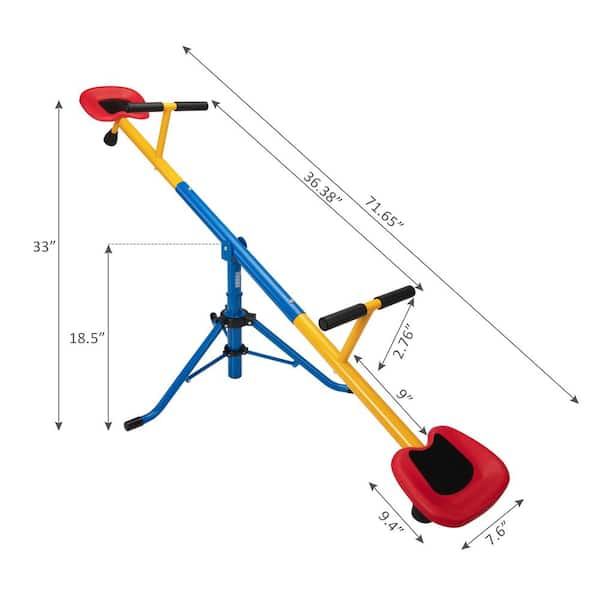
Image Source: images.thdstatic.com
Deciphering Seesaw Length: More Than Just a Number
When we think of a seesaw, we often picture that classic playground fixture, the one that sends kids soaring into the air with a satisfying bump. But have you ever stopped to wonder, “How long is a seesaw?” It’s a question that might seem simple, but the answer involves a fascinating mix of physics, design, and practical considerations. The seesaw length isn’t arbitrary; it’s a carefully chosen dimension that dictates the entire play experience.
Playground Seesaw Dimensions: Balancing Fun and Safety
Playgrounds are vibrant hubs of activity, and seesaws are often at the heart of the excitement. The playground seesaw dimensions are crucial for ensuring both enjoyment and, most importantly, safety. Designers and manufacturers adhere to specific guidelines to create seesaws that are sturdy, appropriately sized for children, and fun to use.
The Standard Seesaw Size: A Common Measure
The standard seesaw size is a good starting point for our exploration. While variations exist, a widely accepted range for the plank of a commercial playground seesaw is between 8 feet (approximately 2.4 meters) and 12 feet (approximately 3.6 meters) long. This length provides enough leverage for children to achieve a good rocking motion without becoming unwieldy or creating excessive forces.
Factors Influencing Standard Size:
- User Age and Size: Standard sizes are generally designed for a broad range of children, typically from preschool to early adolescence.
- Material Strength: The materials used for the plank must be strong enough to support the weight of multiple children and withstand the forces of rocking.
- Safety Regulations: Playground equipment is subject to safety standards that influence dimensions and spacing to prevent injuries.
Backyard Seesaw Length: Tailoring for Home Play
For those looking to bring the joy of a seesaw to their own backyard, the backyard seesaw length might be a more personal choice. While commercial playground standards offer a good benchmark, backyard seesaws can be smaller or adapted to fit available space and the specific ages of the children using them.
Considerations for Backyard Seesaw Length:
- Space Availability: A smaller backyard might necessitate a shorter seesaw to ensure adequate clearance around the equipment.
- Child Development: For very young children, a shorter, more manageable seesaw can be safer and more appropriate.
- DIY Projects: If you’re building your own, you have complete control over the dimensions, but it’s essential to consider structural integrity and safety.
How Big Is a Seesaw? Exploring the Measurement Landscape
So, how big is a seesaw? The term “big” can refer to different aspects. We’ve touched on the length of the plank, but the overall footprint and height are also important.
Seesaw Measurements: Beyond the Plank
When we talk about seesaw measurements, we’re encompassing more than just the length of the rocking board. We also need to consider:
- Plank Width: This affects comfort and the ability of children to sit side-by-side. Typical widths range from 6 to 10 inches.
- Height of the Pivot Point: This is the distance from the ground to the center of the seesaw. It influences the range of motion and the potential height children can reach.
- Overall Footprint: This includes the space the seesaw occupies, including any anchoring or support structures.
Typical Seesaw Length: Common Benchmarks
Let’s delve deeper into typical seesaw length to give you a clearer picture. While 8 to 12 feet is a common range for commercial setups, it’s worth noting the variations.
Variations in Seesaw Length:
- Toddler Seesaws: These are often much shorter, perhaps 4 to 6 feet, and designed for very young children. They may also have a lower pivot point and more stable bases.
- Heavy-Duty or Adult Seesaws: While less common, larger, more robust seesaws might be found in some community parks or recreational areas, potentially exceeding 12 feet.
Metal Seesaw Length: Durability and Design
Metal seesaw length often aligns with the standard playground dimensions. Metal, particularly steel, is a popular material for its durability and ability to withstand heavy use and various weather conditions.
Advantages of Metal Seesaws:
- Strength and Longevity: Metal offers excellent structural integrity and can last for many years with proper maintenance.
- Weather Resistance: Metal, when treated with anti-corrosive coatings, can endure diverse climates.
- Design Flexibility: Metal can be fabricated into various shapes and sizes, allowing for different aesthetic and functional designs.
Wooden Seesaw Length: Natural Appeal and Considerations
Wooden seesaw length also typically falls within the 8 to 12-foot range for playground-grade equipment. Wood provides a natural aesthetic that many people prefer for outdoor play spaces.
Considerations for Wooden Seesaws:
- Wood Type: Hardwoods like oak or treated pine are often used for their strength and resistance to decay.
- Maintenance: Wooden seesaws require regular sealing and treatment to protect them from moisture and UV damage, which can affect their lifespan and integrity.
- Weight and Flexibility: The type of wood and its thickness will influence the seesaw’s weight and how it flexes during use.
Seesaw Balancing Length: The Art of the Pivot
The concept of seesaw balancing length is rooted in physics, specifically the principle of levers. The length of the seesaw plank, in relation to the pivot point (or fulcrum), determines how easily it can be balanced and how much effort is needed to create motion.
The Physics of the Seesaw:
A seesaw is essentially a lever. The plank is the lever arm, and the pivot point is the fulcrum. To achieve balance, the moments on either side of the fulcrum must be equal. A moment is calculated by multiplying the force (the weight of the person) by the distance from the fulcrum.
- Force x Distance = Moment
If two people of equal weight are on opposite ends of a seesaw, and they are equidistant from the pivot, the seesaw will balance perfectly. If one person is heavier, they need to sit closer to the pivot to balance the lighter person who is sitting further away. The seesaw balancing length is therefore intrinsically linked to the distribution of weight and the distances from the center.
How Length Affects Balancing:
- Longer Plank: A longer plank allows for greater distances from the pivot. This means lighter individuals can effectively balance heavier individuals by sitting further out. It also allows for a larger range of motion, potentially leading to higher “air” for the riders.
- Shorter Plank: A shorter plank means shorter lever arms. This typically requires individuals to be closer in weight to achieve balance or for the heavier person to sit very close to the pivot. The range of motion is also reduced.
Common Seesaw Designs and Their Length Implications
Seesaws come in a variety of designs, each with its own considerations for length and functionality.
Traditional Two-Seater Seesaws
These are the most common type, with one seat at each end of the plank.
Length Considerations:
- Standard Range: As discussed, 8 to 12 feet is typical.
- User Interaction: The length is designed to allow two children to comfortably sit facing each other with adequate space.
- Leverage: This length provides good leverage for children of varying weights and strengths to operate the seesaw.
Multi-Seater or Merry-Go-Round Style Seesaws
Some modern designs feature multiple seats around a central pivot, allowing for more than two users.
Length Considerations:
- Plank Length: While the fundamental plank length might still be within the 8-12 foot range for each individual seating section, the overall structure can be larger and more complex.
- Rotation: These often incorporate a spinning element as well as the up-and-down motion, requiring a robust central pivot and careful balancing of all seating positions.
- Safety Zone: The extended nature of these designs necessitates a larger clear safety zone around the entire apparatus.
Animal or Themed Seesaws
These often feature stylized seats or planks that resemble animals, cars, or other shapes.
Length Considerations:
- Aesthetic vs. Function: The overall length is still guided by safety and playability, but the decorative elements might extend beyond the functional plank length.
- Weight Distribution: The shape of the seats and how they attach to the plank can influence weight distribution and the seesaw balancing length.
Material Matters: Impact on Seesaw Length and Durability
The materials used to construct a seesaw significantly influence its potential length, durability, and maintenance requirements.
Table: Common Seesaw Materials and Their Impact on Length
| Material | Typical Length Range (Plank) | Advantages | Disadvantages |
|---|---|---|---|
| Wood | 8-12 feet | Natural aesthetic, good for lighter loads, can be more affordable. | Requires regular maintenance, susceptible to rot and insect damage, can splinter. |
| Metal (Steel/Aluminum) | 8-12 feet | High durability, weather-resistant, strong for heavier loads. | Can get hot in the sun, potential for rust (steel), heavier. |
| Plastic/Composite | 6-10 feet | Lightweight, low maintenance, often brightly colored, weather-resistant. | May not be as durable for very heavy use, can fade in sunlight. |
| Rubber/Recycled Materials | 6-10 feet | Eco-friendly, good shock absorption, safe for young children. | May have limitations in load capacity and design flexibility. |
Safety Standards and the Influence on Seesaw Length
Safety is paramount in playground design, and regulatory bodies provide guidelines that indirectly influence the playground seesaw dimensions.
Key Safety Considerations:
- Clearance Zones: There must be adequate clear space around the seesaw to prevent collisions with other equipment or structures. This impacts the overall footprint dictated by the plank length.
- Fall Height: While not directly about length, the height of the pivot point and the potential height a child can reach influences the required fall surfacing.
- Entrapment Hazards: The design must avoid small gaps or openings where a child’s head or limbs could become trapped. This is relevant to the design of the seats and the connection points.
- Material Durability: Materials must be able to withstand the forces of play and environmental exposure without breaking or degrading, which could lead to unsafe lengths or structural failures.
The chosen seesaw length must work in conjunction with these safety clearances. A longer seesaw will inherently require a larger safety zone.
Frequently Asked Questions about Seesaw Length
Q1: What is the ideal seesaw length for a backyard?
A1: For a typical backyard with children aged 5-12, a seesaw plank length of 6 to 8 feet is often a good balance between playability and space efficiency. If you have younger children or limited space, you might opt for a shorter length.
Q2: Can I make my own seesaw?
A2: Yes, you can make your own seesaw, but it’s crucial to prioritize safety. Research sturdy materials, proper anchoring techniques, and ensure the pivot point is stable and at an appropriate height. Consider consulting with someone experienced in woodworking or playground construction. Ensure your DIY seesaw adheres to general safety principles, even if not formal playground standards.
Q3: How does the pivot point affect seesaw length?
A3: The pivot point’s location relative to the ends of the seesaw plank determines the seesaw balancing length for each user. The closer the pivot to the center, the longer the lever arm for each end, allowing for more dynamic rocking. The height of the pivot also influences the overall motion and the potential for children to get airborne.
Q4: What are the standard safety regulations for seesaws?
A4: Playground equipment, including seesaws, typically adheres to standards set by organizations like ASTM International (in the US) or EN 1176 (in Europe). These standards cover aspects like fall heights, entrapment hazards, surfacing requirements, and material durability. While they don’t always specify exact seesaw length in feet, they dictate dimensions and clearances that influence safe sizing.
Q5: Does the material of the seesaw affect its length?
A5: Yes, indirectly. Stronger materials like steel can support longer planks without compromising structural integrity. Softer or less durable materials might necessitate shorter lengths to ensure safety and prevent breakage. The weight of the material also plays a role in the overall stability and handling of the seesaw.
Q6: What is “seesaw balancing length”?
A6: Seesaw balancing length refers to the distance from the pivot point to the end of the seesaw plank. This length is critical for leverage. For a seesaw to balance, the moments (weight multiplied by the balancing length) on each side must be equal. A longer balancing length provides greater leverage.
Q7: How much space do I need around a seesaw?
A7: This depends on the seesaw’s length and height, but generally, you need a clear safety zone around the entire apparatus. For a standard 8-12 foot seesaw, a minimum of 6 feet of clear space in all directions from the pivot and ends is recommended, extending to a larger zone at the sides where the seesaw reaches its apex. Always check local playground safety guidelines.
Conclusion: The Multifaceted Nature of Seesaw Length
From the playful heights achieved by children to the critical safety considerations for manufacturers, the seesaw length is a dimension that carries significant weight – both literally and figuratively. Whether you’re looking at playground seesaw dimensions, trying to find a standard seesaw size, or contemplating a backyard seesaw length, remembering the interplay between materials, physics, and safety regulations will help you appreciate just how much thought goes into these classic pieces of play equipment. The seesaw balancing length is a testament to the simple yet profound physics that make these structures so engaging. Ultimately, the “right” length is one that maximizes fun while ensuring a safe and enjoyable experience for all who use it.