
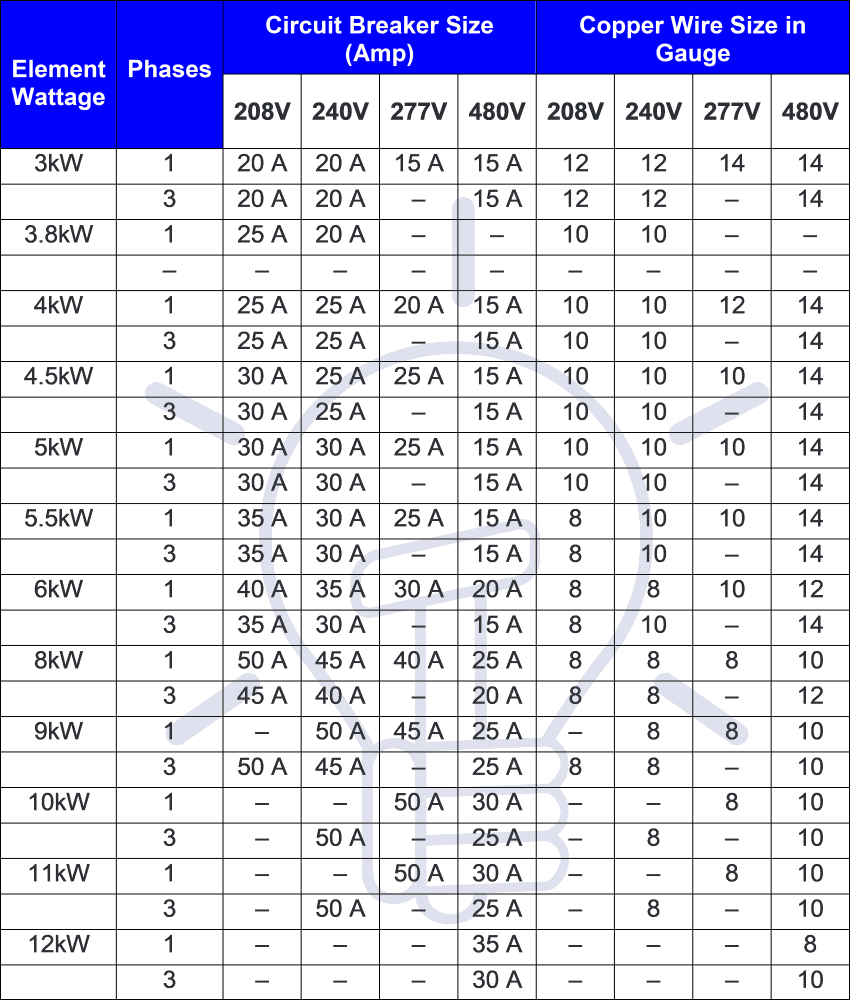
Image Source: www.electricaltechnology.org
What is a circuit breaker and why does its sizing matter?
A circuit breaker is a safety device that protects electrical circuits from damage caused by overcurrent or short circuits. Proper sizing is crucial because an incorrectly sized breaker can either fail to protect your electrical system, leading to fires or damage, or trip unnecessarily, disrupting power.
Key Factors in Determining Circuit Breaker Size
Sizing a circuit breaker correctly involves several critical steps. It’s not a one-size-fits-all process; it depends on the specific electrical demand of the appliance or circuit it’s protecting. We’ll delve into each of these factors to ensure you can make informed decisions.
Load Calculation: The Foundation of Breaker Sizing
The most important step in sizing a circuit breaker is performing a thorough load calculation. This involves determining the total electrical power an appliance or a group of appliances will draw. This calculation helps ensure the breaker can handle the expected current without tripping, but also provides overload protection.
Understanding Amperage
Amperage rating (often shortened to amps or A) is the measure of electrical current. The amperage rating of a circuit breaker indicates the maximum amount of current it can safely allow to pass through before tripping. This is the primary value you’ll be working with when sizing.
Determining Continuous vs. Non-Continuous Loads
Electrical loads are categorized into two types:
- Continuous Loads: These are loads that operate for three hours or more at a time. Examples include lighting in commercial spaces or refrigeration units.
- Non-Continuous Loads: These are loads that operate for less than three hours at a time, such as a toaster or a vacuum cleaner.
The NEC guidelines (National Electrical Code) have specific rules for handling continuous loads. For continuous loads, circuits and their overcurrent protection devices (circuit breakers) must be sized to 125% of the continuous load. This means if a continuous load draws 10 amps, you’ll need a breaker rated for at least 10 amps * 1.25 = 12.5 amps. For non-continuous loads, you typically size the breaker to match the load.
Calculating Wattage and Voltage
To get to amps, you often start with the wattage (power) and voltage (electrical pressure) of an appliance. The basic formula is:
Amps = Watts / Volts
For example, a microwave that uses 1200 watts on a 120-volt circuit draws 10 amps (1200W / 120V = 10A). If this were a continuous load, you’d need a breaker rated for at least 12.5 amps (10A * 1.25).
Examples of Load Calculations
Let’s look at a few examples:
-
Single Appliance: A 1500-watt electric heater on a 120-volt circuit.
- Amps = 1500W / 120V = 12.5A
- If used continuously, you’d need a breaker rated for at least 12.5A * 1.25 = 15.625A. The next standard breaker size up is 20A.
-
Multiple Appliances (in a kitchen, for example): You’d need to sum the wattage of all appliances that could be on at the same time. The NEC provides specific rules for calculating loads for dwelling units, often allowing for demand factors on certain types of loads. For a general workshop or a specific dedicated circuit, you’d typically sum the expected operating wattages.
Wire Gauge: The Circuit’s Highway
The wire gauge is directly related to the circuit breaker size. Wire gauge refers to the diameter of the conductor. Thicker wires (lower gauge numbers) can carry more current safely without overheating. The NEC guidelines specify minimum wire gauges for different amperage ratings.
The Relationship Between Amperage and Wire Gauge
You cannot simply install a higher amperage breaker without ensuring the wire is adequately sized. An undersized wire connected to an oversized breaker is a major fire hazard. If the breaker doesn’t trip when it should, the wire will overheat, melt its insulation, and potentially start a fire.
Here’s a general guide based on common copper wire sizes (always refer to the latest NEC for precise requirements):
| Circuit Breaker Rating (Amps) | Minimum Copper Wire Gauge (AWG) |
|---|---|
| 15 | 14 |
| 20 | 12 |
| 30 | 10 |
| 40 | 8 |
| 50 | 6 |
| 60 | 4 |
| 70 | 3 |
| 80 | 2 |
| 100 | 1/0 |
| 125 | 2/0 |
Important Note: Aluminum wire has different ampacity ratings and requires larger gauges for the same amperage compared to copper wire. This table is for copper.
Factors Affecting Wire Ampacity
Several factors can reduce the safe ampacity of a wire, meaning it can carry less current than its base rating:
- Bundling: When multiple wires are run together in a conduit or cable, their ability to dissipate heat is reduced. The NEC provides tables to adjust ampacity based on the number of current-carrying conductors in a raceway.
- Ambient Temperature: Wires in very hot environments will have their ampacity reduced.
- Conduit Fill: Similar to bundling, running too many wires in a conduit can necessitate adjustments.
When these conditions apply, you may need to select a larger wire gauge than what’s listed in the basic table for a given breaker size.
Understanding Circuit Breaker Types
There are various circuit breaker types, and their function is essentially the same: to interrupt the flow of current. However, they differ in their application and tripping mechanisms.
Standard Thermal-Magnetic Breakers
These are the most common type found in residential electrical panels. They have two main tripping mechanisms:
- Thermal Trip: A bimetallic strip heats up due to the current flowing through it. If the current is too high for too long (an overload), the strip bends and trips the breaker. This is slower acting and designed for sustained overcurrents.
- Magnetic Trip: An electromagnet uses the current flowing through it. If a sudden surge of current occurs (a short circuit protection event), the magnetic field is strong enough to immediately trip the breaker. This is fast-acting.
GFCI (Ground Fault Circuit Interrupter) Breakers
These breakers are designed to protect against electrical shock. They monitor the current flowing out on the “hot” wire and back on the “neutral” wire. If there’s an imbalance (meaning current is leaking to ground, perhaps through a person), the GFCI breaker trips very quickly. They are required in areas where water is present, like bathrooms, kitchens, garages, and outdoors.
AFCI (Arc Fault Circuit Interrupter) Breakers
AFCIs are designed to detect dangerous electrical arcs. Arcs can be caused by damaged wires, loose connections, or faulty appliances, and they are a significant fire hazard. AFCIs are more sensitive than standard breakers and can detect these arcing faults. They are increasingly required by the NEC in many living areas of homes.
Dual-Element Time-Delay Fuses
While not technically breakers, fuses serve the same protective purpose. Dual-element fuses have a thermal element for overloads and a spring-loaded mechanism for short circuits, similar to thermal-magnetic breakers. They are often used in specific applications like motor circuits.
Service Entrance and Main Breakers
The service entrance is where electricity from the utility company first enters your home or building. The main circuit breaker, usually located at the top of your electrical panel, protects the entire electrical system from overloads and short circuits. Its size is determined by the total electrical demand of the building, often calculated based on square footage and the types of appliances used, following specific NEC formulas.
Calculating Service Size
Service entrance calculations are more complex and often involve demand factors. The goal is to size the main breaker and the service conductors to handle the expected maximum load, with a safety margin. This ensures that the utility company’s connection and your home’s main wiring are adequately protected.
NEC Guidelines: The Rulebook
The National Electrical Code (NEC) is the standard for electrical installations in the United States. It provides comprehensive rules and tables for sizing circuit breakers, selecting wire gauges, and ensuring safe electrical practices. Always refer to the latest version of the NEC for current requirements.
Key NEC Sections to Consider
- Article 240: This article covers Overcurrent Protection, detailing the requirements for circuit breakers and fuses, including sizing and installation.
- Article 210: Deals with Branch Circuits, including rules for calculating branch circuit loads and selecting appropriate conductors and overcurrent protection.
- Article 220: Outlines Requirements for Branch-Circuit, Feeder, and Service Calculations, providing the methodologies for load calculations.
Practical Steps to Size a Circuit Breaker
Now that we’ve covered the foundational concepts, let’s walk through the practical steps.
Step 1: Identify the Load
Determine what the circuit breaker will protect. Is it a single appliance, a branch circuit serving multiple outlets and lights, or a dedicated circuit for a high-power appliance like an air conditioner or oven?
Step 2: Determine the Load’s Amperage
- For Appliances: Check the appliance’s nameplate. It will typically list the voltage, wattage, or amperage. Use the formula Amps = Watts / Volts if only wattage is provided.
- For General Circuits: You will need to calculate the total expected load for the outlets and fixtures on that circuit. The NEC provides specific ampacity values for general-purpose circuits based on dwelling unit calculations. For example, a 15A circuit is typically used for lighting and general receptacles, while a 20A circuit is often used for kitchen and laundry areas.
Step 3: Apply the 125% Rule for Continuous Loads
If the load is continuous (operates for 3+ hours), multiply its amperage by 1.25.
- Example: A continuous 8-amp load requires a breaker size of at least 8A * 1.25 = 10A. The next standard breaker size is 15A.
Step 4: Select the Appropriate Wire Gauge
Based on the calculated amperage (including the 125% factor if applicable), choose the correct wire gauge. Refer to the NEC tables or general guides like the one provided earlier. Ensure the wire gauge is rated for the breaker’s amperage.
Step 5: Choose the Right Circuit Breaker Type
- For standard circuits: Use a thermal-magnetic breaker.
- For areas near water or outdoors: Use GFCI breakers.
- For living areas where arc faults are a concern: Use AFCI breakers (or combination AFCI/GFCI).
Step 6: Consider Special Equipment
Some equipment, particularly motors, have high starting currents that are much higher than their running currents. The NEC has specific rules for sizing breakers for motor loads to prevent nuisance tripping. These often involve using inverse-time breakers or dual-element fuses with specific multiplier factors.
Common Mistakes to Avoid
- Oversizing the Breaker: Installing a breaker with too high an amperage rating for the wire gauge. This is dangerous.
- Undersizing the Breaker: Installing a breaker that is too small for the load, leading to frequent nuisance tripping.
- Ignoring Continuous Loads: Failing to apply the 125% multiplier for continuous loads.
- Using the Wrong Breaker Type: Not using GFCI or AFCI breakers where required by code.
- Not Considering Wire Derating: Failing to adjust for conditions like bundled wires or high ambient temperatures.
- Mixing Wire Types: Using aluminum and copper wires on the same circuit without proper connectors.
Safety First: When to Call a Professional
Electrical work can be dangerous. If you are unsure about any aspect of sizing a circuit breaker or working with your electrical panel, it is always best to consult a qualified electrician. They have the knowledge and experience to ensure your electrical system is safe and up to code. This is especially true for service entrance calculations or if you are dealing with major upgrades.
Frequently Asked Questions (FAQ)
Q: Can I replace a 15-amp breaker with a 20-amp breaker?
A: You can only do this if the existing wiring is rated for 20 amps. Typically, 14-gauge wire is for 15-amp circuits, and 12-gauge wire is for 20-amp circuits. Using a 20-amp breaker on 14-gauge wire is a serious fire hazard and a code violation. Always check the wire gauge before changing a breaker size.
Q: What is the difference between a branch circuit breaker and a main breaker?
A: A branch circuit breaker protects a specific circuit (like the one for your kitchen outlets). The main breaker protects the entire electrical system of the house and is usually located at the point where power enters your home, controlling all the branch circuits.
Q: How do I know if I have a continuous load?
A: A continuous load is any electrical load that is expected to operate for 3 hours or more at a time. Examples include lights in commercial buildings that are on all day, refrigerators, or sump pumps that run periodically for extended periods.
Q: What are the risks of an improperly sized circuit breaker?
A: An undersized breaker will trip too often (nuisance tripping). An oversized breaker for the wire gauge can lead to overheating of the wire, insulation melting, and potentially a fire before the breaker trips. An undersized breaker for the load will simply not provide adequate overload protection.
Q: Who is responsible for ensuring electrical code compliance?
A: The installer of the electrical system is responsible for ensuring it complies with the NEC guidelines. For homeowners, this means hiring a licensed electrician for any significant electrical work.
Q: Do I need a special breaker for my washing machine?
A: Washing machines can draw significant current, especially during their spin cycles. For most modern residential washing machines, a standard 20-amp dedicated circuit with a properly sized breaker and wire gauge is usually sufficient. However, always check the appliance’s manual and consult the NEC or an electrician if unsure. Some larger industrial machines might require specific breaker types.
Q: What does it mean for a breaker to “trip”?
A: When a circuit breaker “trips,” it means it has automatically interrupted the flow of electricity in the circuit. This happens when the current exceeds the breaker’s rating, indicating either an overload (too much current for the circuit to handle) or a short circuit (a sudden, massive surge of current due to a fault).